The
last entry devoted to my time in Paris ended with my
stroll through the statue-filled
Jardin des Tuileries. As I pointed out, at the
eastern end of the garden stands there stands another arch—the
Arc de Triomphedu Carrousel—which marks the entrance to the world-famous
Musée du Louvre. That was my next stop on 19 February.
 |
| NB: This is still part of the terrible, awful, no-good, very-bad hair day! |
Now, my friend RC recommended that I skip the Louvre in
favor of the Musée d’Orsay. In the end, I wound up not doing this for two
reasons:
First, as I noted in the
other post, the line for the
Musée d’Orsay
was ridiculous, and while there are certainly some paintings there that I would
have loved to see—e.g., ‘
Whistler’s Mother’—I just wasn’t willing to spend such a considerable chunk of my vacation
time standing in line.
Second, I cannot fully escape the cultural inculcation
I’ve received over my lifetime, meaning that I wasn’t going to pass-up the opportunity
to see one of the world’s most renowned museums and the art it holds.
Sorry RC—this was just one of
those times where I had to pass on your much-appreciated and highly-regarded advice!
Whereas the line at the
Musée d’Orsay was enormous and
unmoving, the one at the Louvre was, shockingly, almost nonexistent. It only
took about five minutes for me to move from the back of the line, through the
security checkpoint (under
I.M. Pei’s spectacular glass
Pyramide du Louvre), and
down to the ticket-lobby.
After about another five minutes (of waiting for a
ticket machine), I had my entry pass.
Now, before I go too much further, I have to say one thing:
those websites that list the Louvre as one of the biggest museums in the world…Are.
Not. Lying! We’re talking four huge, sprawling levels arranged in the shape of
something like the letter ‘A’ laying on its side.
 |
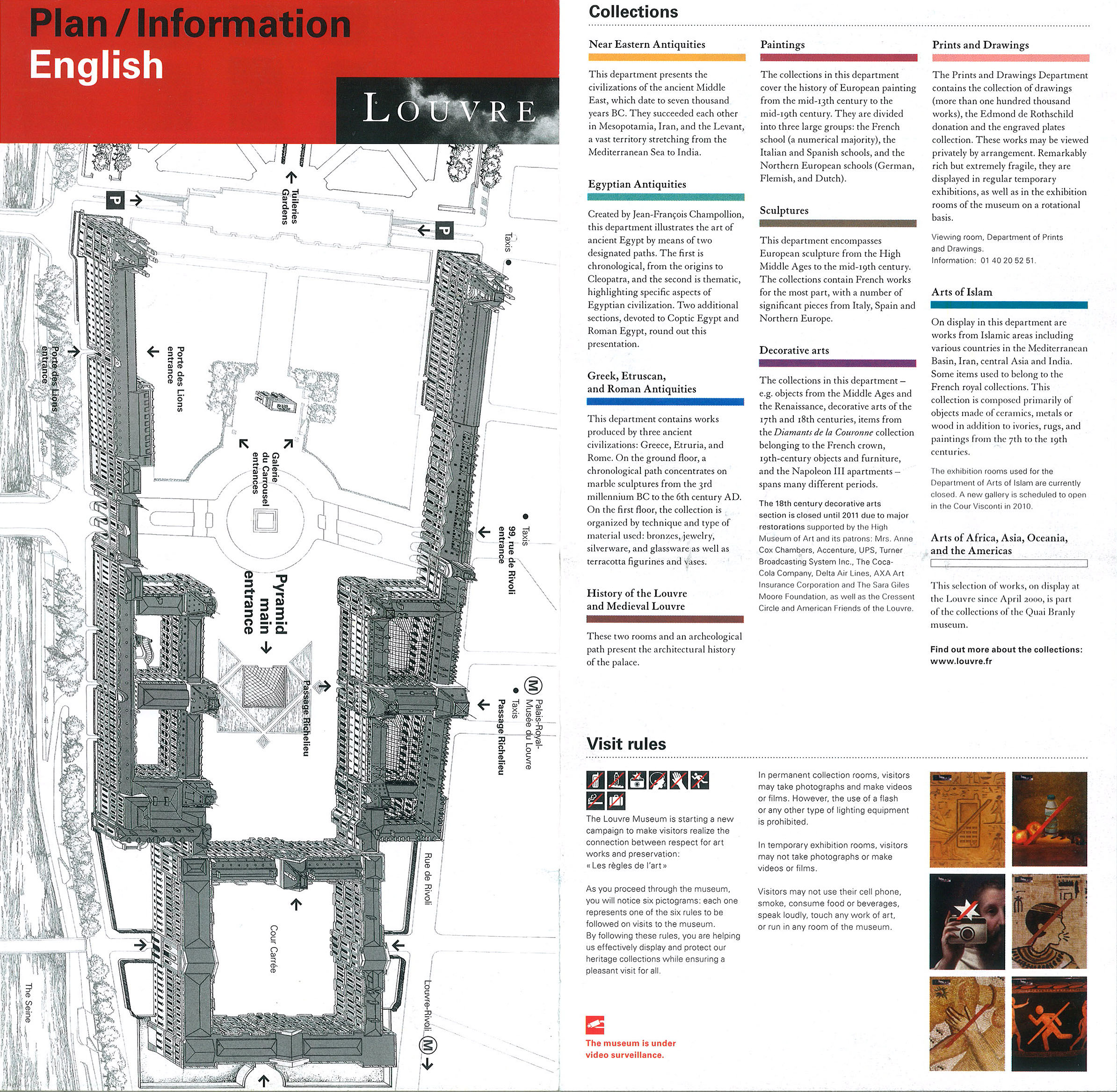
Map--notice the 'No Photography' and other icons in the lower-right.
|
I cannot even begin to tell you how many times I got
lost—and not just ‘Oh, I’m in room 2.61
instead of 2.62’ lost. No, I’m talking about lost as in ‘I’m on a completely different floor and on
the opposite side of the building than I thought.’
But I wouldn’t trade a
moment of that being lost—everywhere I turned was something else incredible.
And there was so much that I didn’t see, simply because I was beyond
overwhelmed and because I could never find it (e.g., Michelangelo's
Captive).
But let’s talk about what I did see…
Standing on 0 (the ground floor), beneath the sparkling
pyramid, I had the choice of three directions to start from: Richelieu, Sully,
or Denon. I opted for Sully, simply because it was the direction I was facing at the
moment, but from there I wound up moving over to Denon because I started seeing
signage that the Mona Lisa was in that direction. (After all, if for some
reason I wound up not seeing anything else the Louvre had to offer, I had to
ensure that I at least saw that famous work!)
As I made my way toward Leonardo’s enigmatic painting, I
came upon a massive marble staircase (the Daru staircase)…and there, at the top
of said-staircase, was the
Winged Victory of Samothrace!
 |
| NB: This is not my photo, but perfectly shows the perspective I was describing above! |
This sculpture, which Julian Bell cites as having been sculpted
circa
190 BC, is one of those artistic works that I’ve wanted to see since I was a child—no
doubt owing to some
Carmen Sandiego-related incarnation I'm sure.
And then, to come
across it so unexpectedly, towering over me in such an epic manner… My
goodness, it was a breathtaking experience!
Equally amazing was the fact that one can just reach out and
touch it! (I’m sure the Louvre—and future generations—would prefer that you
didn’t, of course).
Now, as a quick aside, you may think to yourself after
seeing my photos, ‘Why didn’t he take more pictures? He was at the friggin’
Louvre!’
Well, the answer is that there were many areas where the taking of
photos was prohibited. This did not, of course, stop anyone (including moi)—but
I really did want to try to respect the rules, and so I at least limited my picture taking.
Moving on…
From Victory, I moved into the wing devoted to paintings. I
knew I was getting closer to the Mona Lisa, and so I walked a little faster…
And then, suddenly, there she was, in the center of a partial wall, erected in
the middle of rooms 1.6 and 1.7!
 |
| The 'real' Mona Lisa--behind bullet-proof Plexiglass! |
I kind of felt sorry for all of the other artwork in the
room, because it might as well have been invisible.
At any rate, DaVinci’s
masterpiece is safely secured behind a thick sheet of bullet-proof, light-disrupting Plexiglas-looking
material (meaning that you can finally take photos of it!) and, as other
observers have noted, is much smaller than you would think.
After snapping a couple of pictures, I just stood there for
about 10 minutes…just looking at it, and trying to absorb every moment.
Of
course, I found the experience slightly problematic thanks to a reading I’d just
done for my ‘Realism, Fantasy & Utopia’ class en route to Paris. The essay, John Berger’s ‘Ways of Seeing’—which
was based on the work of Walter Benjamin—said two things that really FUBAR’ed
my ability to just embrace what I was seeing:
1.) ‘When the camera reproduces a painting, it destroys the
uniqueness of its image. As a result its meaning changes. Or, more exactly, its
meaning multiplies and fragments into many meanings’ (12). In essence, what
Berger means by this is that—through the process of reproduction—in today’s
culture when one observes the ‘original,’ rather than focusing on the meanings
that they could decode in that moment, they are instead reminded of the
moment—and its attendant implications and meanings—when they first saw a
reproduction of the image (which likely happened before seeing the ‘original,’
just as I saw countless reproductions of the Mona Lisa before finally seeing
the ‘real’ thing last week).
2.) Furthermore, rather than simply seeing the art for
whatever it is, the act of reproducing artwork (sub)consciously forces you into
thinking of it in terms of a binary (i.e., this is the original, not the
reproduction). As a result, the concept of rarity is affixed to the original, which
in turn drives up the market value of the piece. ‘But because it is
nevertheless “a work of art”—and art is thought to be greater than commerce—its
market price is said to be a reflection of its spiritual value. Yet the
spiritual value of an object…can only be explained in terms of magic or
religion. And since in modern society neither of these is a living force, the
art object…is enveloped in an atmosphere of entirely bogus religiosity’ (14).
MEANING IT’S ALL BULLOCKS AND WHY DID I PAY €10 TO GET IN
HERE TO SEE SOMETHING WHOSE MEANING IS FALSELY AUTHENTIC AND WHOSE MEANING I
CANNOT TRULY COMPREHEND BECAUSE SOMEWHERE ALONG THE LINE I SAW A REPRODUCTION
FIRST?!
Yes, this messed me up.
But, at least I can say I saw the ‘real’ thing—and here’s
another reproduction of it that I made to prove as much:
 |
| Why, oh why, didn't I hop into the bathroom and fix my hair? For goodness' sake! BAD QUEER! |
 |
| I had to do a bit of color-enhancement owing to the Plexiglass, but I did take this image. |
From the Mona Lisa we move to another
object d’art that I’d
wanted to see for as long as I can remember: the
Venus de Milo!
Perhaps it was just the remnants of my earlier pontification
on art that was influencing me—or maybe, by the point I reached this icon of the Roman
Love Goddess, I had just reached the point where I had been exposed to too much beauty
in one sitting—but, despite loving my time in front of the sculpture, I wasn’t
as moved as I’d expected to be.
 |
| And now I've got a face like a moon... *SMDH* |
Still, it really was amazing to finally see the Venus de Milo!
Now, I’ve touched on the ‘big three’ that I—like so many
other tourists—wanted to see while I was at the Louvre. But, by no means does that
mean that this was all I looked at, or all that I enjoyed. In particular, I was
moved by the Renaissance-era paintings in the room flanking the Mona Lisa—like,
really moved. As in: I got a little
misty-eyed.
Regarding the former, David’s skin-tone was this amazing, almost translucent
bluish-white. (And, yes, I acknowledge that as a person from Jerusalem he
should not have been white, but it’s
not like I can go back in time and ‘fix’ Reni’s color palette or racist
tendencies—work with me here!) The severed head is a bit unnecessary—though
Biblically accurate—but that's counteracted to an extent by the amazingly textured fur sash that
David is wearing! Ugh, I wish I had a photo that did more justice to this beautiful piece!
Concerning Campi’s painting, for me it’s all about the
‘window’ into Heaven seen in the upper-right. Again, the photo does this
masterpiece zero justice—the vivid, almost dazzling gold used therein is beyond
description. Likewise the various shades of pink interspersed throughout are
jaw-dropping!
There’s so much more to say about my experience at the
Louvre—almost too much, and so I won’t risk cheapening the adventure by failing
to eloquently express it all.
What I will say by way of conclusion, however, is
that the time I spent there was one of two side-trips (the other being Montmartre) that absolutely made the entire Paris trip into the
amazing experience that it was—I will never forget my time spent within this
grand ol’ palace!