I’m sad to
report that I’m back in the US. However, I’ve still got a lot of stuff to fill
you in on, including my last full day in Amsterdam, so I’d better get started.
Having knocked
out most of the things on my ‘to-see’ list the day before, I devoted 15 May to
just walking around in hopes of stumbling upon some random fun things. It
started off well enough, with a quick visit to Waterlooplein Market. Founded in
the 1800s as a marketplace for Jewish merchants, following World War II it
became (and has remained) a large, daily flea market.
After spending
some time at Waterlooplein, I started heading east, in the general direction of
the Natura Artis Magistra, the
Netherlands’ oldest zoo, assuming such a setting would provide some nice
photos. Sadly, it cost €18,95
to get in and so I ultimately decided to skip it…
Just as a cold
downpour and thumbnail-sized hail started pelting me.
Yes, you read
that correctly: rain and hail. And,
it just so happened that there were no trams or buses nearby. Nor was there
shelter. In all, I was quite uncomfortable by the time I made it back to more
familiar streets.
And of course, that’s when the rain and hail stopped.
At any rate, I
eventually found myself—drenched—standing in front of the Het Scheepvaartmuseum (The National Maritime Museum), which is located in the 17th Century ‘s Lands Zeemagazijn building. I popped in for a quick second, long enough to admire the stunning interior courtyard, before heading back out.
Standing in front of the 's Lands Zeemagazijn building, home of the National Maritime Museum.
Standing there, I spotted a windmill—the only
remaining one in the city proper—about a kilometer away, to the east. Since the
rain had stopped for a moment, I decided to walk over to it and snag a photo or
two.
As I learned
later, the windmill in question is known as the De Gooyer Windmill (a.k.a. ‘the Windmill Bar’). I couldn’t get in to visit it because the adjoining brewer—who now owns the
windmill—was not open yet. Instead, I had a quick bite to eat at a nearby cafe, nestled in
the shadow of its slow-turning blades.
Ominous skies and the De Gooyer Windmill in the background.
From the De Gooyer
Windmill I made my way back into downtown Amsterdam, where I paid quick visits
to Nemo (Amsterdam’s equivalent of Chicago’s
Museum of Science and Industry), and then spent the rest of the day just
wandering around the city aimlessly and trying to avoid the nasty weather.
And yes, as part
of that wandering around, I did stumble upon one of the infamous streets with
the prostitutes behind glass in the Red Light District—though, for obvious
reasons, I did not avail myself of their services. (Though, the gents I saw
leaving their work areas looked pleased enough.)
And, on that
happy note, I’ll bring this entry to a close, and with it my brief excursion to
Amsterdam. It’s a fun city, and one that can seemingly be explored in a
relatively short timeframe if you only have a few days or so and are willing to
push yourself. Not as much fun as Marrakech, mind you, but better than Paris…
After a heavy
first morning in Amsterdam, I decided it was time for a lark. With that in
mind, I started walking toward Amsterdam’s infamous ‘Red Light District,’ by
way of Nieuwe Spiegetstraat. Of course, I became hopelessly lost en route (not
that I minded), and I think the 2km (+/-) walk turned into a much greater
distance.
Eventually, I
found myself standing in Dam Square, which serves as the city center for all intents and purposes. On the western
end of the square stands the Royal Palace, flanked by theNieuwe Kerk
(‘New Church,’ a name given despite its erect in the 15th Century) and another infernal Madame
Tussaud’s Wax Museum (*shudder*). Across from the palace is the National Monument, which memorializes the victims of the Second World War.
In Dam Square, with the Royal Palace behind me.
The Royal Palace (left) and Nieuwe Kerk (right)
After spending a
few minutes in Dam Square (and realizing that I couldn’t get in to tour the
Royal Palace), I confess to wasting some time walking around Magna Plaza, which stands just behind the palace. Basically a shopping mall, I didn’t bother
to go into most of the shops—but the building itself was so gorgeous that I
couldn’t help ducking in for a bit.
Best mall facade ever!
From there, I
continued up Damrak, where my eye was caught by one of those tourist traps
offering canal cruises. I had decided ahead of time, at the advice of my
Stateside friend AR, to take one of these cruises, but I hadn’t actually
arranged one yet. Thinking now was as good a time as any, I ducked in and did
just that. (Ironically, the boat I was eventually to take was called the Anne Frank.)
While awaiting
departure near Amsterdam Centraal, I stopped off for lunch. With money limited
(and since I wasn’t desperately hungry yet), I indulged in another yummy sleeve
of Vlaamse Frites. My goodness, I
love these things!
LUNCH!
Eventually, it
was time to depart. Though our captain-guide was very nice, and the sights
lovely, I confess to finding myself a bit bored. The pre-recorded narration was
not as informative as I would have liked, and the sun passing through the
glass-covering created a greenhouse effect that, when combined with the gentle
rocking of the boat, practically lulled me to sleep.
Nonetheless, I’m glad that
I did it, as I did learn some new interesting facts (e.g., the purpose and
intent behind the different gables, and how they’re still used today as a means
of moving furniture)!
A little over an
hour later, our boat docked near the Amsterdam public library. Now, I know this
will sound strange to some, but I did go walk around the library for a bit. I
had been advised that you could climb to the top for free, and that it offered
an amazing view of the city, so I wanted to do that (and I did).
Upon entering,
however, I also discovered that it was one of the most stunning libraries I’ve
ever been in! To be sure, nothing has yet topped the beauty of Dublin’s Trinity College’s library. But, whereas Trinity’s collection and styling is clearly
traditional and rooted in history, Amsterdam’s is incredibly modern and
sleek—it’s like Ikea came in and built all eight floors for them! In fact, it was so striking
that I went back the next day, too.
By now, it was
getting late and I figured I should start walking back toward the hostel.
(Though I may have made one brief stopover in a coffeeshop on Warmoesstraat.)
More than once, I got completely lost while trying to find my way back—much as
in Paris, I found that I would be walking in one direction, thinking I was
headed south (for instance), only to discover that I was headed northwest (or
some other completely wrong way). It also didn’t help that none of the maps I
had access to included the smaller streets, which just added to the confusion.
Eventually, I
found myself back at the hostel. It was around 5 or 6 PM, my feet were killing
me, and I knew I had another full day of walking the next. So, I gave in to
temptation and took a short nap (with my poor dogs elevated)…except, that short
nap turned into a two-hour nap, and the only reason I woke up then was because
someone else came into the room.
Regardless, I
felt slightly refreshed, and so I got up and headed back out. Still not
completely starved (but knowing that I would be famished later if I didn’t
stop), I bought another serving of Vlaamse
Frites—and I wonder why I’m fat?—which I ate while walking around my
immediate neighborhood some more.
At one point, I
stumbled upon Reguliersdwarsstraat, which was festooned with numerous rainbow
flags. Realizing that this was probably one of Amsterdam’s gay enclaves, I
decided to walk down the street. I was hoping for some gay-centric shopping
(e.g., bookstores and the like), but this particular street was basically just
a bunch of bars.
I did stop by one—a tiny, dead place (it was a Monday night) called Taboo—for two
drinks. The first, my typical Vodka and cranberry. The second, a Heineken,
which Nic insisted I try while in Amsterdam because, supposedly, it tastes
different. (In case you’re wondering, it still tasted like watered-down piss to
me—if I have to drink beer, I’ll stick with Guinness, thank you very much!)
And with that (it
was around 10 PM by now), I headed back to my hostel and caught some
much-needed sleep in preparation for the next day…which I’ll discuss later. :)
My mother thinks
I forgot how to take pictures while in Amsterdam, hence why I haven’t added any
more to my Facebook account, but I told her: I won’t let myself upload them
until I’ve blogged about them. So, here goes…
I woke up
super-early on Monday, 14 May, knowing that there was a lot I wanted to see and
not a lot of time to do it. But first, I needed coffee! Unfortunately, I was up
early enough that there was nary a true coffee shop open. It took almost an hour
before I was eventually able to grab a seat at Broodje Mokum and enjoy a cuppa, so while waiting for that lovely little café to open, I
headed over to the first touristy the thing on my list:
The Homomonumentis a large (albeit easy to overlook) memorial dedicated to all gay and lesbian
persons who have faced persecution. It opened in 1987—the city had just
celebrated the 25th Anniversary of the monument earlier in May, hence the flowers you'll see below—and was the
first of its kind in the world.
Resting on the bank of the Keizersgracht canal,
in the shadow of Westerkerk Church (where Rembrandt is buried),
the Homomonument consists of three large, pink granite triangles set into the
ground. Together, the three small triangles form a much larger triangle.
The
positioning of the the monument's points are intentional: one points toward the
National War Memorial; another toward the Anne Frank House, which I will
discuss further below; and the third toward the headquarters of COC Nederland,
the oldest continuously operating gay and lesbian organization in the world
(founded in 1946).
I spent a good bit of time at the Homomonument, reflecting
on its significance and appreciating its very existence.
Westerkerk Church. The area with the flowers is one of the points of the triangle.
Coffee at Brodje Mokum. I can't read (or speak) Dutch, but I sure pretended like I could...
From the Homomonument and Broodje Mokum, I eventually made
my way over to the second item on
my list: the Anne Frank House and Museum, which is a museum built around the actual house where the Frank family hid from
the Nazis for just over two years. Given the nature of what I was seeing, this
is one area where I respected the request not to take photos or videos. You’ll
just have to take my word for it that it is incredibly moving!
The Anne Frank House (left) and Museum (right)
As part of the
self-guided tour, visitors are led through the ‘public’ side of the building,
from which Otto Frank (Anne’s father) and his colleagues ran their business.
Eventually, guests make their way through a small hole in a back closet—itself
hidden by a large bookcase—and into the small Achterhuis (Dutch for ‘back house,’ and referred to by Frank as the
‘Secret Annex’), where Anne hid away with her parents,sister, and four others
until they were betrayed.
After moving through these small living
quarters—which all together was only about the size of mine and Nic’s former
apartment in the South Loop of Chicago but distributed over two floors, and still had magazine clippings Anne
had glued to the wall to brighten up her own living area—guests make their way
into the two-part museum.
The first part deals with the Frank family’s
imprisonment in the concentration camps (only Otto survived), and the second
part deals with discriminatory acts in a broader context. Throughout the
section devoted to the Frank family, guests are able to view recorded
interviews conducted with Otto and others who knew them. Perhaps the most
poignant moment for me came as I was watching the very last video, which
featured Anne’s father.
It concludes with him talking about how Anne always
kept-up a relatively cheerful façade while they were in hiding, and that he never had even
the slightest inkling that half the thoughts she recorded in her diary were
going through her mind. He finishes by saying in a melancholic tone that he
never really knew his daughter, which just goes to show that a parent never
really knows their child. How sad is that? As if what Otto Frank went through
wasn’t horrific enough, he then had to go to his grave years later thinking
that he didn’t even know his own daughter?
After an emotionally heavy morning, I decided it was time for a change of pace.
I headed over to Amsterdam’sRijksmuseum, which is a national museum devoted to Dutch
arts, craft, and history. There are many famous works here—especially from the
painters Rembrandt and Vermeer(though, sadly,Girl with a Pearl Earring was not on display!)—but the main reason I wanted to go here was because of an
experience Nic had when in Amsterdam.
Museumplein, with the Rijksmuseum behind me.
You see,
according to Nic, when he visited the Rijksmuseum during his study abroad
experience, he was shocked to find figures in the paintings that closely
resembled himself. As he puts it (more or less), he was hit over the head by
his Dutch roots in that moment. Having heard this story on more than one
occasion, I wanted to check out the situation for myself.
My goodness: he
was not kidding, as evidenced by the
photos I snapped below. The
bone-structure, the nose—it’s like looking at various paintings of Nic dressed
in period costumes! It was quite funny, to me, to learn that this was one of
those rare instances where my beloved did not overly exaggerate.
Upon leaving, I
headed around back to one of two large ‘I amsterdam’ sculptures (I saw the
second one later in the day near the new Filmmuseum), which were originally designed to promote
business interests within the city, but quickly became a tourist attraction.
I had
actually never heard of it before, but locals kept suggesting I go there, so I
did. It was...cute, but I really don’t understand why it was being promoted so
heavily by those who live in Amsterdam full-time when there are much more
interesting sights that visitors should be directed toward. Oh well, it’s not
my city so I can’t judge I guess…
Apparently, I am Amsterdam...
The remainder of
my day was spent in the northeastern part of the city, so this seems like a
good place to take a break.
Let’s talk about
Amsterdam a bit, shall we? Or rather, the trip to get there.
You see, my
holiday as a whole was four days long, but two of those days were spent purely
in transit between London and Amsterdam. This is because I decided to use
MegaBus to facilitate my journey.
Now, I know what
you’re thinking:
Brett, you hate the bus!
You would rather walk a mile (or more) than take the bus somewhere local. Why
on Earth would you subject yourself to a 13 hour bus ride?
Me on the bus, on the return journey.
In short, the
answer is because it’s cheap (round-trip tickets were only £20). But even that
low, low pricetag wasn’t the sole reason why I went this route: I also wanted
to get a sense of some other European locales, even if it was from the highway.
After all, it’s taken me 30 years to make it to Europe—who knows when I’ll be
back?
So, on the
morning of Sunday, 13 May, I set off for Victoria Coach Station at o’Dark
early. (Seriously, I left the house at like 5:30 AM!) We got a bit of a late
start, and didn’t actually leave until about 9:15 AM, but the bus wasn’t
crowded—I had an entire row to myself—and everyone was half-asleep, so no one
seemed to care too much.
After crossing
out of the London city limits, I started reading my book (Game of Thrones) since I was already familiar with the sights between
there and the Channel Tunnel. Imagine my surprise, then, when I looked up and
realized that we were actually headed for the ferry rather than the Chunnel!
Suddenly my excitement doubled, and I hurriedly stashed my book and started
soaking up the 'new' surrounding coastline.
With Dover Castle looming above us, itself atop the towering White Cliffs, we passed
through the Port Authority and boarded the giant ship that would take us across
the English Channel.
Dover Castle as seen from the ferry
I made my way
onto the deck, and watched as we left England behind, with seagulls gliding
along in our wake. The ferry crossing itself was quite nice. I spent the entire
time just traveling back and forth along the ship, staring at the shrinking
English coast one minute and the growing French coast the next. I confess to
being surprised by how close they actually are—I expected it to be kind of like
Lake Michigan (where there’s just enough distance between Illinois and Michigan
that you can’t quite see the opposite coast), but for most of the trip I could
make out both bodies just fine!
The White Cliffs of Dover
Calais and the French coast
The ferry docked in Calais, France, which—much as when I
went to Paris—I found myself wanting to explore further. It seems like a
charming seaside town, dotted with dozens of gorgeous steeples. Sadly, the bus
wasn’t scheduled to stop in Calais, so I didn’t have the chance.
We continued
onward courtesy of the A16, cutting across northern France by way of Dunkerque.
(Notwithstanding Dunkerque's significant place in the WWII context, I was again reminded of my earlier trip to France, when I was generally
unimpressed by the passing scenery between Calais and Paris.)
Eventually we crossed into Belgium, which was a great thrill
for me as it was another country I could cross off my list as having seen! Now, there are some who might argue this point—for instance,
Nic doesn’t think it counts unless you stop to eat or sleep. I see the logic in
this argument, but for my own selfish purposes I’m going to ignore said-logic
and say that I’ve been there. It’s also worth noting that we didn’t stop at any kind of
border patrol point. This made me kind of sad because I was looking forward to
having a Belgian stamp in my passport, but I guess it just doesn’t make sense
to have checkpoints across all of the roads that cross European borders.
Upon crossing into Belgium, we started heading east. Though
not listed on the manifest, we stopped briefly inGentso that the bus driver
could trade with another. We were given about 10 minutes to get off the coach
and stretch our legs—so now I can say that I have not only driven through, but
also set foot on Belgian soil—but
since we were in a hotel parking lot there wasn’t much to see or do.
My only photo of Gent--just something to remember that I was there, however briefly, LOL!
Eventually we loaded back on, and continued onward. About an
hour or so later, we arrived in Bruxelles. Excepting the traffic, which was
atrocious, I thought the capital of Belgium (and the de facto capital of the EU) looked to be a beautiful old city. We
passed the gorgeousNationaleBasiliek van het Helig-Hart (Basilica of
the Sacred Heart), and I even caught a glimpse of the Atomium sculpture before stopping at Bruxelles’ main bus hub for those passengers switching
there.
As in Gent we were given the opportunity to get off the
coach and stretch our legs, but this time we had a full 30 minutes and there
was much more to see. (Mostly, however, I just walked around the terminal and
surrounding area, as I was terrified of missing the bus.)
Out and about in Belgium...sort of.
All too soon we were on our way again, cutting through
Antwerpen before crossing into The Netherlands proper. Much like the non-city
parts of Belgium, The Netherlandian regions known as Brabant andSouth Holland
seemed to be mostly farmlands, though gorgeous nonetheless.
Sadly, I didn’t see
a single tulip along the way, and I only saw a handful of windmills (though the
latter grew more frequent as we neared North Holland).
We finally arrived at our final destination—Zeeburg P&R
Coach Park at Zuiderzeeweg—at about 9:50 PM local time, from whence I hopped on
one of the trams and headed to Amsterdam Centraal Station, and then on another
that would take me to my hostel in-time for my 11 PM check-in.
Amsterdam Centraal Station (taken 15 May 2012)
My hostel (taken on 15 May 2012)
I actually missed my stop on the second tram because I
didn’t realize you had to both press a buzzer to let the driver know you want
off (as on a bus) and then a second
buzzer to actually open the tram doors (like on the DLR).
Fortunately, it was
only a short walk back to the Prinsengracht
stop from where I was, and I still made it to check-in in time—and,
somehow, even at that late hour it only seemed like dusk! There was plenty of
natural light to see by as I found my way back to Prinsengracht and then on to
a street called Leidsegracht, where
my hostel was located overlooking a canal.
After checking-in, I realized how hungry I was. And, since
the sun still hadn’t completely disappeared—again, it was about 11 PM at this
point—I made my way out to find food. I quickly found a place serving vlaamse frites (i.e., fries/chips
drowning in mayo) and made a fast, cheap meal out of that!
Having found a quick meal and drink, I returned to the hostel and hit the hay
in preparation for the next day’s adventures—but more on that later!
[NB: Unless I remember something significant that I forgot here, I probably won't post anything about the return-trip, as it's pretty much the same here but in reverse. The only exception is that on the way home I packed a chocolate-covered waffle (bought in Amsterdam the day before), which I wanted to eat until I was in Belgium—get it?]
As of today—6 May 2012—that’s all I have left
of my time in London. As usual, I’m behind with this thing, but didn’t want
this milestone to pass by without saying a little something about it.
All in all, this timeframe marks the beginning of a period
of transition—things here draw to a close, as I begin the trek back to my own
weird version of ‘normality.’ And it’s not just the big things that are
concluding, like my semester as a University of East London student. It’s also
the little things, like the huge canister of coffee I’ve used throughout most
of my stay finally drying up (the day after classes ended, ironically). Let’s ignore the coffee for a second, though, and look at my
time as a student instead.
UEL Docklands Campus
Because the US Olympic team will be staying in UEL’s
dorms, the entire semester calendar was out of whack. Basically, we turned in
midterms, had two weeks of Easter Break, one week of classes, and then our
finals were due.
It was a whirlwind, crazy experience—and if you’ve been
following me on Facebook, you know the experience was both taxing and
moody-making. Nonetheless, I persevered, and in the end I think I handed in
three strong final works.
Most likely, I won’t know how I did on those final projects until I’m
back home, but I can talk about how I did on my midterms, as well
as offer some final feedback on my experiences in the corresponding modules:
‘Cultural Politics: Power & Contemporary Social Change’
(CC1202; you can find the module descriptionhere):
Though it served as mostly a refresher course for me, I did enjoy this course quite a
bit. The instructors, SM and DS, were my favorites, and really knew what they
were talking about. Also, I walked away feeling like I had a much better
understanding of Marx—though I still prefer Foucault for his focus on questions of identity.
My CW1 (midterm)
assignment was, literally, just the first draft of my final piece. A reflexive work, it explored gay men’s participation in the act of
marthoning/triathloning as a form of body-modification and self-surveillance
(in the Foucauldian sense) rooted in the discourse of HIV/AIDS and the idealized
(gay) male form. On CW1 I scored First-Class marks (the equivalent of an ‘A’),
and the assessor’s feedback listed my work as 'a very substantial and scholarly
case study that uses excellent examples.’ Based on the early feedback I
received on CW2, I’m fairly confident that I’ll receive First-Class
marks on the completed work as well.
‘Realism, Fantasy & Utopia’ (CC2202; you can find the module
description here): Whereas DS was the co-instructor in the aforementioned class, this module was solely
hers. And it was amazing—by far, it was the most brilliant of the courses I took
at UEL. My love of this class was not solely based on our phenomenal guide,
however—equal credit goes to the amazing friends I’ve made therein, amongst
them TvH, RAS, SV, and AR!
As far as my midterm goes, I also received
First-Class marks on this one. It was a rather easy assignment, wherein we
merely had to explain the concepts of realism, fantasy, and utopia. As a funny
aside, one of the critiques DS offered of my work was that she felt I was too
quick to privilege the perspective of the artist/author—she and I have
subsequently agreed to discuss this further, as this is an argument I tend to
get into with everyone. I strongly feel that too much credit is already given
to the reader, and that rather than privileging either the author or the reader, one needs to pay equal lip-service
to both perspectives. After all, to overlook the author’s intent de-historicizes
and depoliticizes the work.
Based on the early feedback I received on my final
essay—a critique of American Horror Story
as a heteronorm-affirming Gothic text—I think DS and I are much more
in-sync this time around. This second piece was approached from a Feminist and
Queer theory perspective, and DS seemed really excited when she read the draft
version. I’m hoping for First-Class marks on this essay and, with her help, I’m
hoping to submit it to the Watercool
Journal for publication—if accepted, that would be the second piece I’ve
had electronically published in a peer-reviewed journal!
‘Culture, Power & Resistance in the 21st Century’ (CC3202; you can find the module description here): By far—by leaps and bounds, and fathoms and light-years—this was my least
favorite of the three classes. The instructor was highly disorganized, often
came across as condescending toward me, and lacked time-management skills. I
highly recommend that Columbia students do not take this class.
As a result of
myriad problems I had in this class—which, to be completely fair, included the
resistance I developed after one too many failures to meet what I consider good
teaching practices—my CW1 assignment from this class only garnered a 68 (i.e.,
‘B’ / 2.I classification). I don’t hold out hopes for a higher score from my
CW2 assignment, as the instructor replied with his feedback right before the
deadline—5 full days after the date
he agreed to. Fortunately, I suspected something like that might happen, and so
I asked DS for feedback as well. With her help, I was able to turn my work into
something that should at least enable me to pass the class.
Overall, my experience with UEL was a good one. I definitely
miss my home-uni, despite it’s countless problems—and I definitely miss
CCC’s technology infrastructure, ‘cause UEL’s is atrocious—but the University
of East London has been a nice classroom-away-from-home, and I will be
eternally grateful for this amazing opportunity!
So, what now?
Well, as I noted earlier, it’s a time of transition. The
biggest thing on the horizon once I return to Chicago is my participation in
the Chicago Marathon (26 miles). Given that I’ve never run that distance
before—in addition to triathlons, I’ve only ever done a half-marathon—I’ve had
to start training here. Yesterday I went for my first 3 mile run of the season.
It wasn’t bad, but it was a bit chilly—9˚C/48˚F, with a cold drizzle—and a bit
slower than I wanted. Ah, well. By the time I return to Chicago on 5 June, I’m
supposed to be running 7 miles.
Speaking of the marathon, I should probably take a brief
second to tell/remind folks why I’m doing it. You see, for the third year in a
row, I am part of the amazing Team to End AIDS (T2) but, this year I’m putting
my bike and wetsuit aside, and solely workin’ the running shoes! (Get it?
‘solely’ and ‘running shoes’? It’s a shoe-joke.)
Take a moment to watch this short video, as it tells you a little more about the journey I'm about to embark upon:
However, in order to train with T2 I have to raise (a minimum) of $1200 by July 1st for the AIDS Foundation of Chicago (AFC).
HIV/AIDS continues to be a very real problem today, even though it’s not always
talked about in the US. In fact, every 9 1/2 minutes someone in the United States
is infected with HIV, and each year people grieve for loved ones whose lives
have been claimed by the disease. Fortunately, AFC—which was founded in 1985 by
community activists and physicians—is leading the fight against HIV/AIDS, and
striving to improve the lives of people in the Chicago area who are affected by
this pandemic. By funding prevention programs and vital services such as
medical care, food and housing, AFC works to stop new infections while helping
to keep people with HIV/AIDS alive until the day there’s a cure.
So here’s the skinny:
On top of wanting to overcome a new physical challenge (and achieve a
fit-in-the-British-sense body), I desperately need help in raising $1200 for
the AIDS Foundation of Chicago this year. As of right now, I only have $540 to
go! Not only will sponsors be joining me in the fight against HIV/AIDS, but
they will also be supporting me in the pursual of a personal goal that—even a
year ago—I never considered possible.
All one has to do is visit my fundraising page and click on the ‘Sponsor Me’ button in the upper left-hand corner (or, if interested in making alternative
payment arrangements—which includes sponsorship by volunteerism—just let me
know). Any and all donations are appreciated, including those from people
living outside of the U.S., and they’re tax deductible to boot!
AC, JD, AT, Nic, and Me after completing the 2011 Chicago Triathlon with T2.
Other than that, the plan is simply to make the most of my
remaining 30 days abroad.
I’ve certainly already started in regards to
celebrating my time here—a certain less than stellar photo of me drinking a Mojito
out of a suitcase attests to that (thanks, TvH and LD). But I’ve got some other
things planned too. For instance, on Wednesday I’m going to go watch as The
Queen and Duke of Edinburgh make their way to Westminster for the State Opening
of Parliament. Also, I’m meeting my friend BC—she and I met during my trip to
Morocco—for coffee tomorrow morning. And, finally, I’ve officially scheduled my
final international sojourn during this trip: I’ll be going to the Netherlands
(Amsterdam) from 13-16 May, and since I’m going by bus(!) I’ll have a chance to
see the northern part of France and Belgium as well!
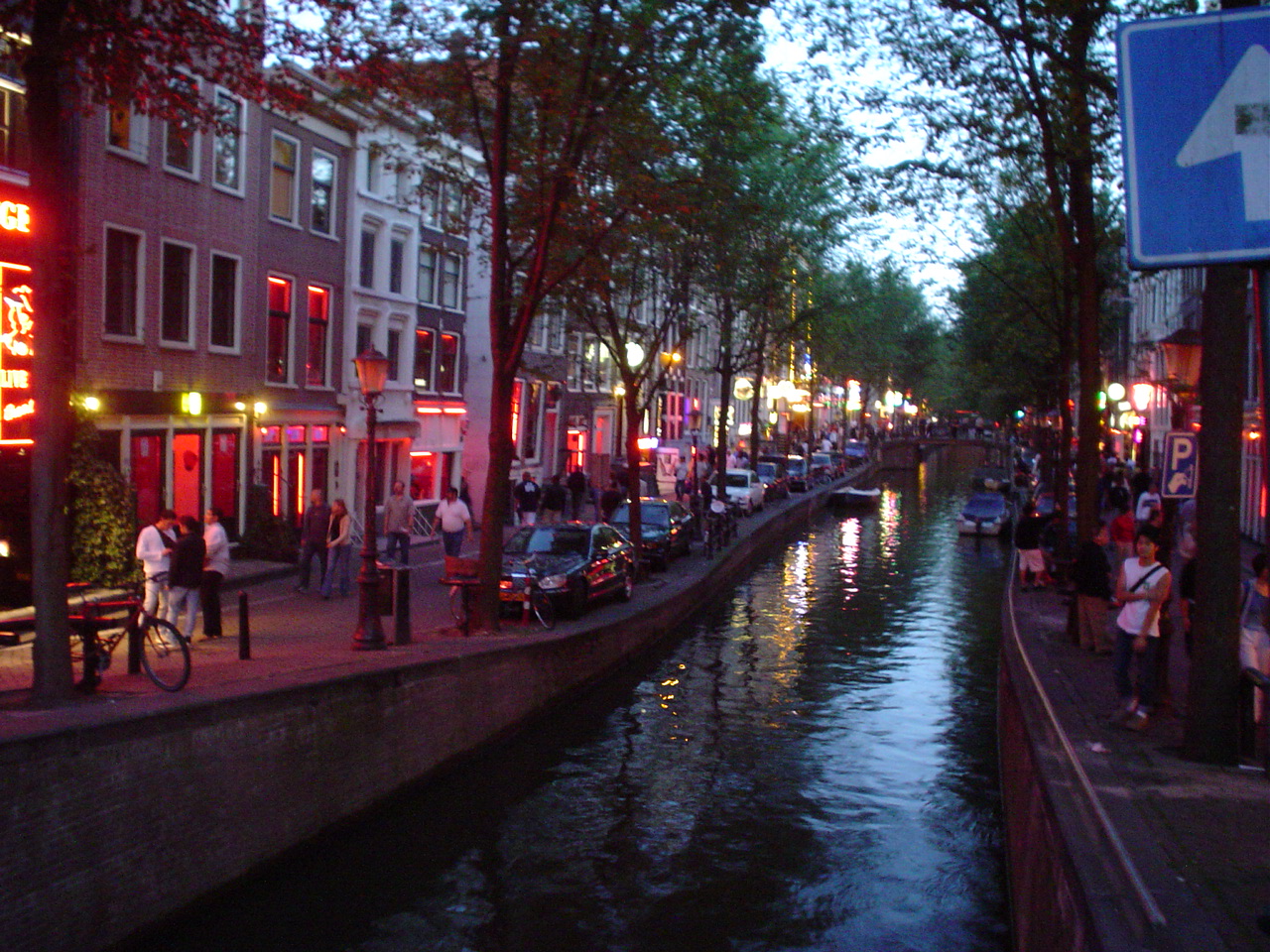
Amsterdam's Red Light District. [NB: This photo is not mine!]
Oh, yes, the next few weeks will be very exciting!