Showing posts with label Windsor Castle. Show all posts

Friday, June 15, 2012

Hampton Court Palace


I’m back with another belated entry!

On 28 May 2012, EN and I made a trip to Hampton Court Palace. This trip was important for me, as people who know my fascination with the monarchy have always asked if I made it there during mine and Nic’s first trip in 2008. We did not—instead, we went to Hatfield House, where Elizabeth I learned she was to be queen following her sister’s death, on that trip. So, this time, it was imperative that I visit one of the primary residences of King Henry VIII.


Me, standing outside the Main Entrance into the Base Court

Map of Hampton Court Palace, courtesy of the palace itself.

Originally built in the early 16th Century for the infamous Cardinal Wolsey, after the latter lost favor it was turned over to the king. The front half of the palace is reflective of Tudor construction, and closely resembles the other remaining palace from Henry’s reign, St James’s

Today, visitors to this section of the palace are able to walk through the former king’s kitchens and apartments, as well as undertake a ‘tour’ of the young Henry’s life.  

Regarding the kitchens, it was interesting to see how meals were turned out for such a large court, including the line of massive roasting spits and fireplaces, and the seldom considered offices belonging to the bureaucrats in charge of monitoring the incoming and outgoing (read: consumed) stores.


One of a line of four or five roasting fires, each of which could accommodate 7 spits.

Even more interesting to me than the kitchens, however, were the king’s apartments. 


I took a lot of photos of the Great Hall in particular. Aside from being simply gorgeous, it was also the last medieval hall of its type built for the English monarchy. 


The Great Hall, near the King's Dais and Table

We were also able to enter the Great Watching Chamber (a large room, complete with medieval board games and a bathroom), which is positioned just outside the king’s private rooms, and where courteous would hang out in hopes of catching a moment of Henry’s time. 

From there, we moved into one of two long hallways. The first features the adjoining room where paiges slept and awaited orders, and the second leads to both the King’s Council Chamber and the special room overlooking the Royal Chapel reserved for the sovereign. 


This King awaits his advisers in the Council Chamber

The Royal Pew, overlooking the Royal Chapel. (It's crooked because we weren't allowed to take photos directly.)

Now, one of these hallways is supposedly haunted—in fact, it’s referred to as the Haunted Gallery—but I can’t recall exactly which. Maybe both? I’m pretty sure the audio-tour suggested that it was the former, but I’ve also heard that the supposed ghost is that of Henry’s ill-fated wife Catherine Howard, and that she lurks near the chapel. (You can read more about the Haunted Gallery here and watch a brief video about other haunted happenings at Hampton Court here.)

The second distinctive section of the palace—an add-on, if you will—was built in the Baroque style at the behest of Queen Mary II and her co-regnant, King William III, almost 100 years later. Within this section, guests can visit the private apartments of the aforementioned, as well as the Georgian apartments.

The W&M section--you can see the edge of the Tudor section near the top of the hedge on the left.

Queen Mary’s apartments had been transformed, owing to a exhibition titled ‘The Wild, The Beautiful, & The Damned’—basically, paintings of upper-class women and kingly mistresses who modeled for risqué portraits during the Stuart era—so there wasn’t much to see there, sadly. King William’s apartments, on the other hand, were gorgeous. 

After ascending the stunning—nay, magnifispeldant (because magnificent and splendid on their own don’t do it justice) King’s Staircase, visitors cross into the King’s Guardchamber, where his protectors…well, basically hung out and showcased their hardware. 


A King ascends the King's Staircase

The King's Guardchamber

From there, guests move through a series of receiving chambers, many with corresponding canopied thrones and one which—as we saw at Windsor—was the official bedroom used for bidding the king goodnight before he retired to a private one. 


How dare they put a rope up to keep me from the throne!

I've informed Nic that I want our bed to look like this.

Eventually, we crossed through the king’s real bedroom, his private office, and even got a peek at the more intimate…ahem, throne. (That’s right, I’m talkin’ about the Royal Loo.)


Not splinters for the sovereign when he sits!

Sadly, we weren’t really able to tour the Georgian apartments—those used by Kings George I and II—because we simply ran out of time. But EN and I did run through that section, so we could at least say we were there. 

It was actually a bit creepy, as it was entirely deserted—even the docents were missing—and we both experienced an eerie ‘we’re not alone’ vibe about the whole section. I actually kind of wish we had seen a spook, as it would have added to the memories, but alas we only had the feelings to go by.


The Cartoon Gallery

Having discussed the interior of Hampton Court Palace, I want to take just a second to address the other thing it’s primarily known for: the gardens and grounds. They were beautiful! That being said, two things of particular note to be found there are the Hampton Court [Hedge] Maze—which I successfully navigated my way out of before EN, who challenged me to a race—and the ‘Great Vine’, which holds the Guinness World Record for being the largest grape vine. (If you’re wondering, it was planted in 1769, still produces a crop of grapes annually, and had at least one branch that was 246’ long as of 2005.)


The Great Vine

So, that’s the gist of mine and EN's day at Hampton Court Palace. It’s a bit expensive to get into—less so if you have a student ID, buy your tickets online in advance, etc.—but certainly worth the trip if you ever find yourself in London with nothing to do (as unlikely as that is)!

Tuesday, May 8, 2012

Windsor Castle (Part IV): The State Apartments


Let’s finish with my trip to Windsor Castle, shall we? (Especially since I plan on having many more photos to discuss over the coming weeks!) After visiting St George’s Chapel and Queen Mary’s Dolls’ House, I made my way—alongside EN and AT—into the main part of the castle.


The top of the Grande Staircase
We climbed the Grand Staircase—which is filled with glistening arms and armor, and dominated by a statue of Queen Victoria (that I was sadly not able to photograph due to palace officials)—and moved toward…

THE STATE APARTMENTS

Suffice to say, these Apartments are a bit grander and more formal than mine and Nic’s tiny studio apartment. In fact, you could probably fit our entire building in some of these rooms. But, such size is necessary given the functions they hold (e.g., a cozy dinner for 162 of The Queen’s closest dignitary friends). And as far as beauty goes, the Apartments house works of art by the likes of da Vinci and Rembrandt, and armor once worn by the likes of King Henry VIII.

Visitors to Windsor are allowed to visit the following State Apartments (whose names are somewhat deceptive at times):

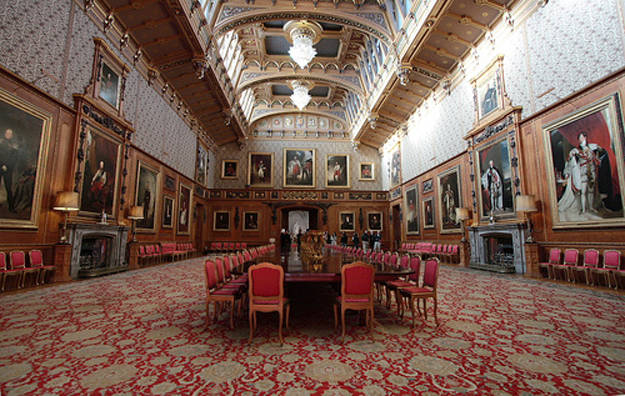
The Waterloo Chamber: Built to honor the defeat of Napoleon, this chamber was once an open courtyard. Today it holds many famous paintings, the largest known seamless rug in existence, and is used to stage concerts and other private performances.


[NB: This image is not mine!]

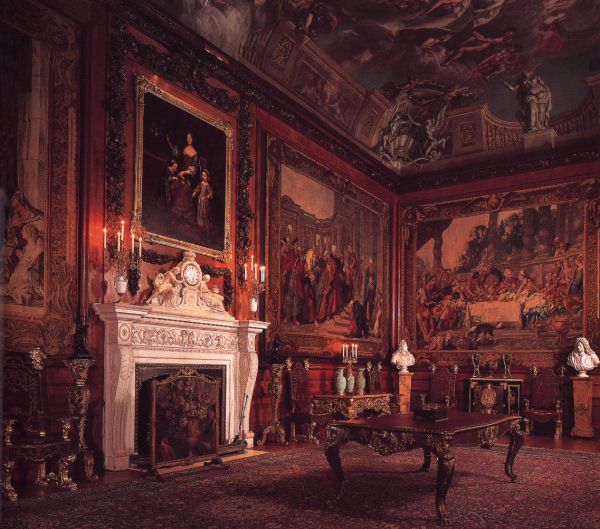
 The King’s Drawing Room: This room features many works of art, and a clock from 1730 that still plays music!


[NB: This image is not mine!]

 The King’s Bedchamber: Though there is a bed, the Sovereign does not actually sleep here. Rather, it is used for formal ceremonies (i.e., telling the King goodnight—formally—before he goes to bed elsewhere).


[NB: This photo is not mine!]

 The King’s Dressing Room: This room has served as both the Sovereign’s private bedroom and, later, as a dressing room. Now it holds a collection of Italian Renaissance paintings.


[NB: This image is not mine!]

 The Queen’s Drawing Room: Like the King’s Drawing Room, this chamber features many impressive works of art, including royal portraits of various Tudors and Stuarts. Also in this room is the famous Portrait of Charles I in three positions by Van Dyke. 


[NB: This image is not mine!]

 The King’s Dining Room: Located between the Queen’s and the King’s Apartments, the room served as the dining room for King Charles II.


[NB: This image is not mine!]

 The Queen’s Ballroom: As its name suggests, this long room was used for dancing (though I have a hard time imagining so many large gowns in such a narrow room!).


[NB: This image is not mine!]

 The Queen’s Presence Chamber and Audience Chamber:  The former is essentially an anteroom used by visitors before they are brought before Her Majesty in the Audience Chamber. (NB: Given that they are open to visitors, I doubt the current Queen actually uses these rooms for this purpose—though I could certainly be wrong!)


[NB: This image is not mine!]

 The Lantern Lobby: This room marks the spot where a private chapel once stood. It is also the spot where the 1992 fire broke out, which is commemorated with a large plaque.


[NB: This image is not mine!]

 St George’s Hall: This room is ginormous! At 30’ x 185’, this room is used for State banquets—a 175’ long dining room table is brought in which can seat up to 162 guests. There are also panels on the ceiling and elsewhere that are inscribed with the names of various knights. According to one source, the plain white shields mark Garter Knights were have been disgraced by crime or treason.


[NB: This image is not mine!]

 Also on display in St George's Hall is the black armor used by the King's / Queen's Champion from the time of King James I through George IV. It is this figure's role to act as the champion of the new Sovereign at their coronation, in the (unlikely) event of a challenge to the throne being issued. It was required of the Champion that (s)he ride, in full armor, into Westminster Hall during the coronation banquet and await any challengers. (NB: The Sovereign—by virtue of rank—could not face his or her challengers in single combat.) 

A purely ceremonial position today, Queen Elizabeth II's current Champion is Lieutenant-Colonel John Lindley Marmion Dymoke, Lord of the Manor of Scrivelsbry and the Manor of Telford—he acted as Standard-Bearer of the Union Jack at Her Majesty's coronation ceremony in 1953.


Moving on... since The Queen wasn’t in residence, we were also allowed to visit some of the...

SEMI-STATE APARTMENTS

These Apartments were created for King George IV in the 19th Century. Today, Queen Elizabeth II uses them for entertaining. These rooms are made up of the Green and Crimson Drawing Rooms, the State Dining Room, the Octagon Dining Room, the China Corridor, the Grand Reception Room, and the Garter Throne Room.

This last one is the one I’m most interested in. Before being converted, the Garter Throne Room was actually two separate rooms, the King’s Presence and Audience Chambers. Today, it is where The Queen conducts investiture ceremonies for new Knights and Ladies of the Garter prior to their installation in St George’s Chapel on Garter Day.


The Queen's throne is the white chair in the distance.
[NB: This image is not mine!]

Now, you may be asking yourself, ‘What is Garter Day, and who are these Knights and Ladies?’

Well, this is the highest order of chivalry that one can be invested with in England, and its doling out is entirely at the discretion of the Sovereign. Membership is limited to the Sovereign, the Prince of Wales, and no more than 24 others at any one time (meaning that new members have to wait an existing knight or lady vacates their position). The emblem is a blue garter with the motto ‘Honi soit qui mal y pense’ (‘Shame upon him who thinks evil upon it’) embossed in gold. The Order was founded in 1344 by King Edward III.

In addition to Queen Elizabeth II and Prince Charles, other current members include: Prince William; the Princess Royal; the Dukes of Kent, Gloucester, York, and Wessex; the Kings of Spain, Sweden, and Norway; the Queens of Denmark and the Netherlands; the Emperor of Japan; former Prime Ministers Margaret Thatcher and John Major; and Baroness Soames (the only surviving daughter of Winston Churchill).


[NB: This image is not mine!]
[NB: This image is not mine!]

 Well, that’s all that I have to say about the interior—especially since we (obviously) couldn’t visit the section cordoned off for the Royal Family’s private Apartments. 

(However, you can see them from the outside in the photos below of the Upper Yard. The wall farthest away is where the private Apartments are located, and the wall running along the right-hand side is for official guests of Her Majesty. The entrance seen in the middle is the exterior entrance to that section.)


I hope you’ve enjoyed this little play-by-play of my trip to Windsor, and that you haven’t minded too much my geeking out!

Until next time…

Sunday, May 6, 2012

Windsor Castle (Part III): Queen Mary's Dolls' House


Time for part three of my trip to Windsor Castle…

If you’ve been following along, it should be abundantly clear that I have a fascination with the various Queens who have reigned from Windsor over the last 175 years: Victoria, Alexandra, Mary, Elizabeth (the Queen Mum), and Elizabeth II. Well, this particular entry is devoted to an object bearing the name of the middle figure, known also as Queen Mary of Teck.


Queen Mary [NB: This image is not mine!]

The object in question—promoted as one of Windsor’s biggest ‘attractions’—is…

QUEEN MARY'S DOLLS' HOUSE:

This idea for this magnificent piece of craftsmanship is credited to the queen’s cousin, Princess Marie Louise. You see, it was well known at the time that Queen Mary was fond of collecting miniaturized objects (e.g., Fabergé animals). So, following a pleasant visit with her cousins Mary and George V, during which time they showered her with hospitality, Princess Marie Louise decided to create the dolls' house as a token of her gratitude. After gaining The Queen’s permission, the princess began consulting with the eventual designer of the not-so-tiny dwelling.

Queen Mary's Dolls' House

 According to the Royal Collection website (which is fun and interactive, and allows visitors to explore the dolls' house in great detail),

Queen Mary’s Dolls’ House is the largest [built on a scale of 1:12], most beautiful, and most famous dolls’ house in the world. Built for Queen Mary, consort of King George V, by the leading British architect Sir Edwin Lutyens between 1921 and 1924, it includes contributions from over 1,500 of the finest artists, craftsmen and manufacturers of the early 20th century. From life below stairs to the high-society setting of the saloon and dining room, a library bursting with original works by the top literary names of the day, a fully stocked wine cellar and a garden created by Gertrude Jekyll, no detail was forgotten—the Queen’s Dolls’ House even includes electricity, running hot and cold water and working lifts. Each room, is fully furnished in every way, and waiting to be explored. (Royal Collection Website

The Saloon (top), The Dining Room (bottom), the Storage Room with tiny crowns (middle-left)

 The level of detail, as noted in the detail above, is incredible! 

Designed to show how the Royal Family lived in the 1920s, the dolls’ house has tiny wine bottles filled with the actual vintages on the label, replicas of famous books and paintings (some of which have been skillfully created by the original artists), and even miniature toilet paper rolls in the bathrooms. 

The Library
 
And, as noted, the plumbing (with hot and cold running water) and electricity actually work—once every year, the close the exhibit and flush the system to keep everything going!

Following its completion, Queen Mary’s Dolls’ House was put on display at the British Empire Exhibition (1924-25) to raise money for the Queen’s myriad charities.

It truly is an amazing piece of artistry, and worth seeing if you ever make it to Windsor!

Until next time…

Tuesday, May 1, 2012

Windsor Castle (Part II): He's Not A Damned Alien; He's A Dead Body!


Back for part two of my trip to Windsor Castle…

After watching the Changing of the Guard ceremony, the group made a brief stop in the Middle Ward to admire the Round Tower, before heading down to the Lower Ward. At such time, we made our way into St George’s Chapel. 

The Lower Ward. St George's Chapel is on the right.


NB: This image is not mine!


ST GEORGE'S CHAPEL 

This beautiful place of worship was started by Edward IV in 1475, but not completed until the reign of Henry VIII. Within its walls are buried 10 monarchs—one day that number will be 11, as this is where Her Majesty, Queen Elizabeth II, will be buried when she passes away. (She will likely be the last of the monarchs buried in the chapel, as space has become an issue.)

Now, being both a history geek and a fan of burial spots, you’ll forgive me (I hope) for droning on this entry. But I want to highlight some of the important figures buried here, as they have all changed the course of history in one way, shape, or form.

The first person I want to talk about was actually not a monarch. Princess Charlotte Augusta was the only (legitimate) child of the man who would become King George IV. She was also the only eligible heir to the Throne amongst George and his brothers. The public adored her, especially since her grandfather (King George III) was quite mad, and her father and uncles were despised for their hard-partying and lavish, irresponsible spending habits! Charlotte was seen as a breath of fresh air, and there was great hope for her reign. Sadly, at the age of 21, she died due to complications from childbirth. The baby was stillborn. 

This threw the Royal Family into a state of panic! George IV was in poor health and, due to the long life of their father, he and his brothers were all getting old—and, suddenly, there was no heir to the Throne in the next generation. The king and his brothers engaged in a frenzied push to produce a new one, and eventually one of George’s younger brothers had a daughter…England’s future Queen, Victoria. One of the most famous rulers in history almost wasn’t.

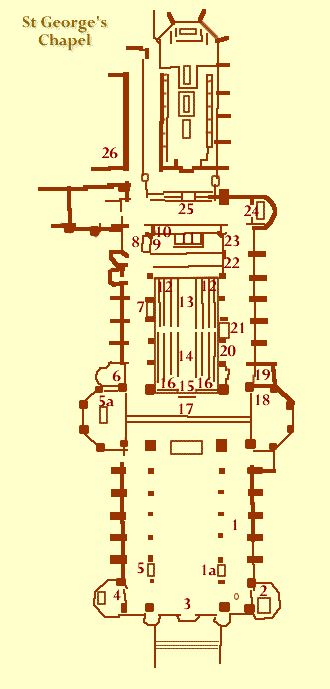
It has been said that the public mourning for Charlotte was akin to that which was seen when Diana, Princess of Wales, died. Charlotte's memorial in St George’s (#4 on the map above) reflects that love, and depicts her ascent into Heaven with angels at her side (one of whom holds her baby). 

Sadly, because you aren’t supposed to take photos in St George’s (meaning I had to be underhanded about it—literally), I wasn’t able to get a clear photo.


What it looks like in-full. [NB: This image is not mine!]

 Almost directly across from Princess Charlotte’s memorial (#5 on the map) is an above-ground vault containing the remains of Queen Elizabeth II’s grandparents, King George V and Queen Mary

These two fascinate me, and they were the main ones whose tomb I wanted to see this time around (when I was here before, I hardly knew anything about them). I’ll have more to say about them later—when I discuss George’s younger brother, ‘Eddy’ (Prince Albert Victor), I will addresses one of the things I find specifically fascinating about this royal couple—but for now I just want to make mention of other things.

Regarding George V, we have him to thank for the Royal Family’s current surname. Past names—like Tudor, Stuart, and Plantagenet—are well known in popular history. But the name given to Queen Victoria’s descendants (by way of her husband, Prince Albert) was less enduring: House Saxe-Cobourg and Gotha

During World War, I the family name became a propaganda tool, when figures such as H.G. Wells criticized the Royal Family for its Germanic name. Wells even went so far as to call the Royal Court ‘alien [i.e., German] and uninspiring’. In response, George (allegedly) declared, ‘I may be uninspiring, but I’ll be damned if I’m an alien!’ 

To waylay such criticisms, the decision was made to change the Family’s surname to something undeniably British: Windsor. (During Queen Elizabeth II's reign, the name has changed again, becoming Mountbatten-Windsor, to reflect her husband's family.) 


King GeorgeV and Queen Mary. [NB: This image is not mine!]

 Queen Mary is a bit more interesting in my opinion. Terribly shy and reserved, she was nonetheless a pillar of strength and resolve when need-be. Anecdotally, this can be seen in her quest to return Family heirlooms that were sold off by George IV and his brothers to support their out of control spending habits. 

It has been said that when May (as her family called her) would find an object once belonging to the Royal Family, she would…suggest quite directly that it should be returned. It didn’t matter to her who was in possession of the object at the time—what mattered to her was that it was an important piece of history that should never have left the Family’s possession in the first place. After making her not-so-subtle demand, the Queen would then sit down, and not get up again until the object was being packed-up for its return (making polite small-talk the entire time, no matter how uncomfortable those around her were). Thus, people would hide these valued possessions if they knew she was coming. 

Something else worth noting about Queen Mary is that we have her to thank for the current model of Royal duties. Never one to be inactive, the queen paid daily visits to various galleries and museums throughout most of her life. However, during the First and Second World Wars, this constant need to be ‘doing’ transitioned into daily visits to hospitals and areas that had been devastated by attacks. In addition, she and her Ladies-in-Waiting were constantly organizing clothes- and food-drives to help those who were in need. Undoubtedly, the current Queen (Elizabeth II) was greatly influenced by her grandmother’s seemingly inexhaustible commitment to service, and has modeled her own actions after Mary’s.

Architecturally, I want to note one thing about King George and Queen Mary’s tomb. The King died in 1936, and the effigy of him was sculpted around the same time. But Mary was aware that the women in her line tended to live long lives, and she wanted her own effigy to be both accurate and of an age corresponding to her husband’s. Thus, she ordered the sculpting of her cenotaph at the same time as George’s, so their representations in death would look as they had in life at the time of his passing. 


(For the record, Queen Mary died in 1953, almost twenty years later. May lived to see her eldest son’s elevation to Kinghood and subsequent abdication, her second son’s elevation to Kinghood and subsequent coronation, and her granddaughter’s elevation to Queenhood. She died 10 weeks before Queen Elizabeth’s coronation, but left instructions that the ceremony should proceed as-planned. It did.)


One of my favorite photos: Queen Elizabeth II, Queen Mary, and the Queen Mother at the funeral service for King George VI. [NB: This image is not mine!]

Down the way from King George and Queen Mary, and off to the side (#6 on the map) is a small chapel. It is here that Queen Elizabeth II will be buried one day, alongside her parents—King George VI and Queen Elizabeth (the Queen Mother)—and younger sister

Similar to Queen Victoria, George VI is a monarch that almost wasn’t. His older brother, who was proclaimed King Edward VIII upon their father’s death, abdicated before his coronation so that he could marry an American divorcee named Wallis Simpson. His brother's choice of love over duty (thankfully) thrust the shy, stammering ‘Berty’ (as the family called him) into the unexpected role of King. I really don’t have much to say about him, as it’s his wife that I find far more interesting.


The Queen Mother, as she became known upon her daughter’s ascension to the Throne—her proper title would have been ‘Elizabeth, Queen Dowager,’ but it was thought that title was too close to her daughter’s and would cause confusion—lived to be over 100 years old. Like her mother-in-law, Queen Mary, the Queen Mum was constantly on-the-go, and she was a force to be reckoned with. 

The Queen Mother was famous, among other reasons, for refusing to leave her husband’s side during World War II, even though it meant living under the constant threat of attack—she even trained with and carried a gun during this time, so that she could defend herself and her family in the event of an invasion. It is said that Hitler referred to her as the most dangerous woman in Europe. Whether or not that’s true, it’s an interesting anecdote. 


King George and Queen Elizabeth survey damage to Buckingham Palace following a bombing that barely missed them. [NB: This image is not mine!]

Another story about the Queen Mum that delights me to no end goes as follows: following a gala one evening, she was talking to the playwright Noel Coward. She noticed Coward occasionally making eyes at some nearby soldiers posted along a staircase, and whispered, ‘I wouldn’t if I were you, Noel; they count them before the put them out.’ 

(If you find yourself questioning the plausibility of such a public acknowledgement of Coward’s sexuality, I add the following: it is rumored that he carried on a long affair with the Queen Mum’s brother-in-law, the Duke of Kent, which certain members of the family knew about.) 

Yet another witty comment attributed to the Queen Mum in this vein was her rebuttal to a Minister that suggested the Royal Family not employ gay men: ‘We’d have to go self-service.’ 

All-in-all, a fascinating and hilarious woman.

Sadly, for the rest of these I wasn’t able to get photos—there were just too many officials around, and I didn’t want to get kicked out. Nonetheless, numbers 13 and 14 on the map above mark the spots where more ‘big names’ are buried: King Henry VIII and his wife Jane Seymour, and Kings Charles I (don’t worry—they sewed his head back on), Georges III and IV, and William IV. King Edward IV is buried at #8 and Henry VI is at #22.  

Queen Victoria’s successors (and the current Queen’s great-grandparents), King Edward VII and his wife Queen Alexandra, are at #23. I am especially said that I didn’t get an image of their tomb, as Queen Alexandra is another interesting figure. 
 

King Edward and Queen Alexandra. [NB: This image is not mine!]
NB: This image is not mine!

The last notable burial (in the Albert Memorial Chapel, not seen on the map) I want to discuss is Prince Albert Victor of Clarence and Avondale. The eldest child of King Edward and Queen Alexandra, he should have succeeded his father as England’s king. Instead, he preceded his father (and grandmother) in death, leading to George V’s eventual ascension. 

What I find intriguing about the prince is that, prior to his death, he was engaged to Mary of Teck—the woman who would marry his brother, George, less than a year later. In part, this union was made at the urging of their families. Adding to the awkwardness (and as mentioned already), King George and Queen Mary were both terribly shy. However, they bonded over their mutual love for the deceased prince—though this wasn’t the only factor—and, over time, they grew to love and cherish each other in the same way. (Their affection for one another was always expressed through letters, as their shared shyness prevented them from communicating their love directly). 


Engagement Photo of Prince Albert Victor and May. [NB: This image is not mine!]

Engagement Photo of Prince George and May, less than a year later. [NB: This image is not mine!]

All in all, it’s a terribly fascinating story and—as with Princess Charlotte—one cannot help but wonder how different things might have been had either of these heirs apparent not died.

One final note about St George’s Chapel: this is where the annual Ceremony of the Garter takes place, which is attended by The Queen and her Garter Knights. But more on that in a later entry…