Showing posts with label Montmartre. Show all posts

Tuesday, March 6, 2012

Paris: From Churches to Gay Bars (With a Bit of Bohemia In-Between)


So, in a little over 24 hours I will be boarding a plane for Marrakech, Morocco. Yes, this li’l bird’s going to Africa, courtesy of my amazing and brilliant and thoughtful hubby!

But, this means that I really need to get my butt in gear in terms of finishing up my blog entries about Paris. So, here goes…

19 February (still):

As I left Notre Dame, it was late afternoon—but my time in Paris was limited, and so I hopped on the Paris Metro and made my way north! A short while later, I found myself emerging from the Anvers metro stop, and to my right—atop a steep hill—sat the magnificent Basilique du Sacré-Cœur.


This gorgeous building (the Basilica of the Sacred Heart of Paris) sits atop the butte Montmartre, and offers an unparalleled view of Paris—but I’ll come to that in a moment. First, I have to tell you about my adventure en route from the metro to the hilltop. 

So, it’s almost a completely vertical climb from the street to the top of the butte, and along the way—starting at the basilica’s gates, unfortunately—are small groups of hustlers looking for money, and they stand in tight knots so that you cannot avoid them entirely.

But I’m savvy, right? 

I recognized them right off the bat as hustlers, and wasn’t interested in playing their reindeer games. 

So, as I’m walking by, one of them gets in my face and starts asking if I wanted a trinket to remember my visit. Without stopping, I held up my hand and politely said, “No thanks.”

Well, the problem was that I held up my hand, because as soon as I did so he slipped a loop of red thread over my index finger and tightened it so that I couldn’t pull my hand free. I immediately protested, telling him to take it off and that I wasn’t interested (nor was I paying for what he was trying to sell me—one of those ‘friendship bracelet’ things that we all made in elementary and middle school). But, my new-found friend and kidnapper of my finger wouldn’t budge, and vowed that he would never charge me for something like this, that it was just a gesture of good will, blah blah blah…

Using my own treasonous finger as a weapon against me, the man proceeded to twine the offending red thread with additional white and black threads, making a bracelet which he eventually removed from my finger long enough to affix to my wrist...

And then the cheeky bastard had the nerve to demand 5€ for it!

I laughed in his face, told him he was dreaming, and chucked him a penny (I figured that was even more offensive than not giving anything) as I pushed past him. 

Suffice to say, he was not thrilled. But neither was I.

Then, not fifteen feet away, another one from the same group accosted me. This time I kept my hands in my pocket as I scoffed and said that I had already been caught by one of his other con-artists friends and that I wasn’t about to be caught again. 

Unfortunately (again), this one wouldn’t take no for an answer—he physically grabbed me by the forearm as he still (ostensibly politely) told me that I should stay and talk with him. I promptly took out both hands, gave him a mighty shove, and told him to bugger off. (And then I ran the rest of the way up the hill, where I was finally safe.)

So, now that I’m safe, I can tell you about the view. 

Truly, the vista from the Basilique du Sacré-Cœur was even more incredible than the one from the Eiffel Tower (which I’ll discuss in a later entry). The only thing you couldn’t really see properly was the Eiffel Tower itself—it was there, of course, just blocked by some trees.

Playing with the panoramic setting...

The bad hair day continues...

Peek-A-Boo...I see you!

After leaving this magnificent building, I headed slightly west and deeper into Montmartre. Now, let me just take a moment to talk about this amazing district. In many ways, my all-too-brief time spent here was my favorite part of the French excursion. 

Beginning in the late 1800s, the area became a favorite for party-goers and artists. At various times Montmartre has played host to nightclubs like the (in)famous Moulin Rouge and artists such as van Gogh and Picasso. And I can tell you that its role has not changed much in the subsequent years: the Moulin Rouge still stands, and (according to the owner of my hostel) it is still possible for starving, homeless artists to find temporary and free lodging within the district’s limits.

I was never able to find any proof of it, but I’d also like to think—and to a certain degree I simply feel as if—one of my favorite musical artists, the legendary Eartha Kitt, was a frequent visitor to Montmartre during her European 'exile' years. This fantasy is (falsely) bolstered by one of my favorite songs of hers, ‘Everything Changes’ from the much-maligned Mimi Le Duck. 

One of my favorite lines within that song goes, ‘One time at Montmartre / I drank gin with Sartre”...


So, in honor of Eartha Kitt’s character’s drink with Sartre—and for all of the talented men and women (known and unknown) who have called this stunning area ‘home’ over the years—I settled down to enjoy a glass of wine (I don’t do gin). 

I did so in a lovely little square called the Place du Tertre, at an equally charming, friendly restaurant called Chez la Mère Catherine, surrounded by paintings undoubtedly meant to attract the eye of unsuspecting tourists. (In fact, I was reminded of the scene from that old episode of I Love Lucy where Lucy, Ricky, and the Mertzes all wind up buying the replicas of the same painting from a ‘street artist’ who sells them to the foolish American tourists.)

I love the random older woman (who looks a bit like my paternal grandmother) who's totally crashed the photo!

As I mentioned earlier, in many regards this was the highlight of my trip. The air was both relaxed and excited in the same moment, and the people—from my server, to the manager (who made a special trip out to see how I was doing), to the couple at the table next to me—were all so friendly! Similarly, the weather was perfect. Sitting outside and drinking wine, all while surrounded by lovely old buildings and attractive paintings…it was tres magnifique!

Sadly, I knew I had to leave Chez la Mère Catherine eventually, and so with a heavy heart I settled the bill and was on my way once more. With help from a local business owner, I found my way along winding, twisting streets (passing, as it happens, the actual Café des 2 Moulins, where the title-character in the film Amélie worked—unfortunately, I didn’t find that out until it was too late, so no pictures).

After losing myself once or twice, I finally found myself standing before the famous windmill belonging to the Moulin Rouge:


She let me know they were 'bout the cake, straight out th' gate!

Now, I’d love to say that I got tickets to see a show at the Moulin Rouge…but tickets were between 100-200€. No way was I paying that much to see a bunch of scantily clad women. (Hell, I’m not even that keen on seeing that sight for free!) So, instead, I just snapped a photo or two and was then on my way again…
I wasn’t sure where to head next—the other big things on my list were going to happen the next day—so I just started walking.

And walking.

And walking.

A little over 3 miles later, I found myself (at dark) standing in front of Notre Dame—by way of the Louvre—once more. Circle complete.
And, since I was near le Marais once more, I decided to stop and have a drink (or two) amongst mes collègues hommes gais. But since I hadn’t eaten recently I got some food at Caffe Vito first—foolishly accepting Nic’s encouragement to order the steak tartare. Don’t get me wrong, if it was just the raw meat I would have been fine…but, I swear, it was the onions and green peppers(?) that did me in! Why people insist on putting those damnable things in everything is beyond me! 

(Ah well, at least the waiter was hot—oh-so-hot: slim, tight gray jeans, early- to mid-twenties, with curly dark hair, green eyes, and just the tiniest patch of black chest hair peeking through his low-cut white shirt!—and so was the guy at the table across from me, who kept eying me flirtatiously and ordering extra items while I struggled to eat my own dinner...not that I noticed either of them of course.)
So, with my belly (more or less) full, I circled the area a couple of times, trying to decide which bar I was going to work my nerve up to entering… In the end, I hit-up three of them (shockingly, each one was easier to enter after an additional drink): The Tropic Cafe, L’Open Cafe, and eventually Raidd Bar (which, I swear, was not nearly as scandalous and seedy when I was there as their website makes it seem…then again, I never went downstairs!).

Thus (finally) concludes my first full day in Paris.

*Whew*

Sunday, February 26, 2012

Paris: The Louvre


The last entry devoted to my time in Paris ended with my stroll through the statue-filled Jardin des Tuileries. As I pointed out, at the eastern end of the garden stands there stands another arch—the Arc de Triomphedu Carrousel—which marks the entrance to the world-famous Musée du Louvre. That was my next stop on 19 February.


NB: This is still part of the terrible, awful, no-good, very-bad hair day!

Now, my friend RC recommended that I skip the Louvre in favor of the Musée d’Orsay. In the end, I wound up not doing this for two reasons:

First, as I noted in the other post, the line for the Musée d’Orsay was ridiculous, and while there are certainly some paintings there that I would have loved to see—e.g., ‘Whistler’s Mother’—I just wasn’t willing to spend such a considerable chunk of my vacation time standing in line. 

Second, I cannot fully escape the cultural inculcation I’ve received over my lifetime, meaning that I wasn’t going to pass-up the opportunity to see one of the world’s most renowned museums and the art it holds. 

Sorry RC—this was just one of those times where I had to pass on your much-appreciated and highly-regarded advice!

Whereas the line at the Musée d’Orsay was enormous and unmoving, the one at the Louvre was, shockingly, almost nonexistent. It only took about five minutes for me to move from the back of the line, through the security checkpoint (under I.M. Pei’s spectacular glass Pyramide du Louvre), and down to the ticket-lobby. 


After about another five minutes (of waiting for a ticket machine), I had my entry pass.
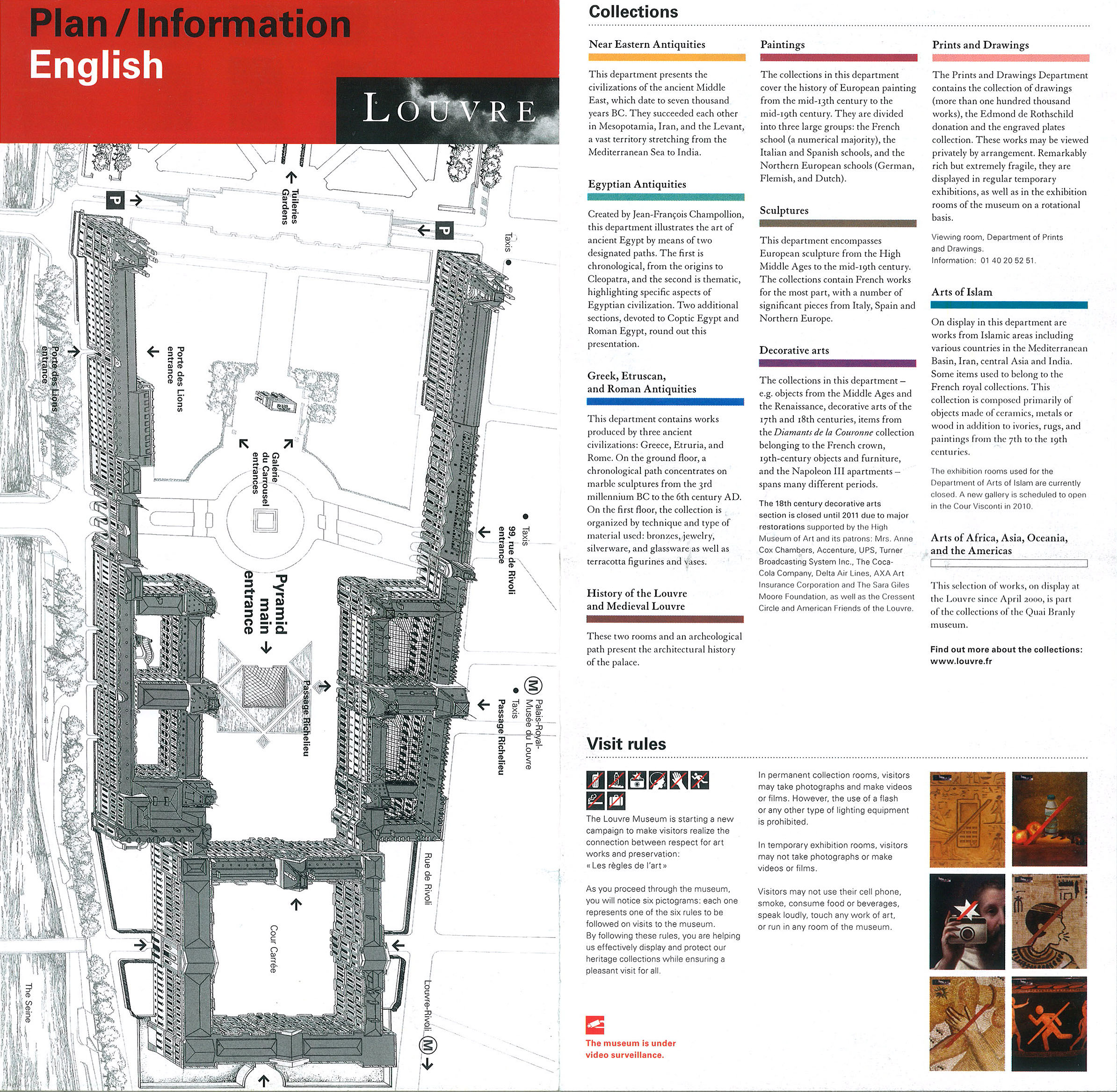
Now, before I go too much further, I have to say one thing: those websites that list the Louvre as one of the biggest museums in the world…Are. Not. Lying! We’re talking four huge, sprawling levels arranged in the shape of something like the letter ‘A’ laying on its side.


Map--notice the 'No Photography' and other icons in the lower-right.


 I cannot even begin to tell you how many times I got lost—and not just ‘Oh, I’m in room 2.61 instead of 2.62’ lost. No, I’m talking about lost as in ‘I’m on a completely different floor and on the opposite side of the building than I thought.’ 

But I wouldn’t trade a moment of that being lost—everywhere I turned was something else incredible. And there was so much that I didn’t see, simply because I was beyond overwhelmed and because I could never find it (e.g., Michelangelo's Captive).

But let’s talk about what I did see…

Standing on 0 (the ground floor), beneath the sparkling pyramid, I had the choice of three directions to start from: Richelieu, Sully, or Denon. I opted for Sully, simply because it was the direction I was facing at the moment, but from there I wound up moving over to Denon because I started seeing signage that the Mona Lisa was in that direction. (After all, if for some reason I wound up not seeing anything else the Louvre had to offer, I had to ensure that I at least saw that famous work!)

As I made my way toward Leonardo’s enigmatic painting, I came upon a massive marble staircase (the Daru staircase)…and there, at the top of said-staircase, was the Winged Victory of Samothrace


NB: This is not my photo, but perfectly shows the perspective I was describing above!

This sculpture, which Julian Bell cites as having been sculpted circa 190 BC, is one of those artistic works that I’ve wanted to see since I was a child—no doubt owing to some Carmen Sandiego-related incarnation I'm sure. 

And then, to come across it so unexpectedly, towering over me in such an epic manner… My goodness, it was a breathtaking experience! 


Equally amazing was the fact that one can just reach out and touch it! (I’m sure the Louvre—and future generations—would prefer that you didn’t, of course).

Now, as a quick aside, you may think to yourself after seeing my photos, ‘Why didn’t he take more pictures? He was at the friggin’ Louvre!’ 

Well, the answer is that there were many areas where the taking of photos was prohibited. This did not, of course, stop anyone (including moi)—but I really did want to try to respect the rules, and so I at least limited my picture taking.

Moving on…

From Victory, I moved into the wing devoted to paintings. I knew I was getting closer to the Mona Lisa, and so I walked a little faster…

And then, suddenly, there she was, in the center of a partial wall, erected in the middle of rooms 1.6 and 1.7!

The 'real' Mona Lisa--behind bullet-proof Plexiglass!

I kind of felt sorry for all of the other artwork in the room, because it might as well have been invisible. 

At any rate, DaVinci’s masterpiece is safely secured behind a thick sheet of bullet-proof, light-disrupting Plexiglas-looking material (meaning that you can finally take photos of it!) and, as other observers have noted, is much smaller than you would think.

After snapping a couple of pictures, I just stood there for about 10 minutes…just looking at it, and trying to absorb every moment. 

Of course, I found the experience slightly problematic thanks to a reading I’d just done for my ‘Realism, Fantasy & Utopia’ class en route to Paris. The essay, John Berger’s ‘Ways of Seeing’—which was based on the work of Walter Benjamin—said two things that really FUBAR’ed my ability to just embrace what I was seeing: 

1.) ‘When the camera reproduces a painting, it destroys the uniqueness of its image. As a result its meaning changes. Or, more exactly, its meaning multiplies and fragments into many meanings’ (12). In essence, what Berger means by this is that—through the process of reproduction—in today’s culture when one observes the ‘original,’ rather than focusing on the meanings that they could decode in that moment, they are instead reminded of the moment—and its attendant implications and meanings—when they first saw a reproduction of the image (which likely happened before seeing the ‘original,’ just as I saw countless reproductions of the Mona Lisa before finally seeing the ‘real’ thing last week).

2.) Furthermore, rather than simply seeing the art for whatever it is, the act of reproducing artwork (sub)consciously forces you into thinking of it in terms of a binary (i.e., this is the original, not the reproduction). As a result, the concept of rarity is affixed to the original, which in turn drives up the market value of the piece. ‘But because it is nevertheless “a work of art”—and art is thought to be greater than commerce—its market price is said to be a reflection of its spiritual value. Yet the spiritual value of an object…can only be explained in terms of magic or religion. And since in modern society neither of these is a living force, the art object…is enveloped in an atmosphere of entirely bogus religiosity’ (14).

MEANING IT’S ALL BULLOCKS AND WHY DID I PAY €10 TO GET IN HERE TO SEE SOMETHING WHOSE MEANING IS FALSELY AUTHENTIC AND WHOSE MEANING I CANNOT TRULY COMPREHEND BECAUSE SOMEWHERE ALONG THE LINE I SAW A REPRODUCTION FIRST?!

Yes, this messed me up.

But, at least I can say I saw the ‘real’ thing—and here’s another reproduction of it that I made to prove as much:

Why, oh why, didn't I hop into the bathroom and fix my hair? For goodness' sake! BAD QUEER!

I had to do a bit of color-enhancement owing to the Plexiglass, but I did take this image.

From the Mona Lisa we move to another object d’art that I’d wanted to see for as long as I can remember: the Venus de Milo!

Perhaps it was just the remnants of my earlier pontification on art that was influencing me—or maybe, by the point I reached this icon of the Roman Love Goddess, I had just reached the point where I had been exposed to too much beauty in one sitting—but, despite loving my time in front of the sculpture, I wasn’t as moved as I’d expected to be.


And now I've got a face like a moon... *SMDH*


Still, it really was amazing to finally see the Venus de Milo!


Now, I’ve touched on the ‘big three’ that I—like so many other tourists—wanted to see while I was at the Louvre. But, by no means does that mean that this was all I looked at, or all that I enjoyed. In particular, I was moved by the Renaissance-era paintings in the room flanking the Mona Lisa—like, really moved. As in: I got a little misty-eyed. 

I think the two paintings which I was most moved by in this area were Reni’s ‘David vainqueur de Goliath’ (c.1604) and Campi’s ‘Les Mysteres de la Passion du Christ’ (c.1569). And with both of these amazing paintings, it’s the usage of colors that really got to me.

Regarding the former, David’s skin-tone was this amazing, almost translucent bluish-white. (And, yes, I acknowledge that as a person from Jerusalem he should not have been white, but it’s not like I can go back in time and ‘fix’ Reni’s color palette or racist tendencies—work with me here!) The severed head is a bit unnecessary—though Biblically accurate—but that's counteracted to an extent by the amazingly textured fur sash that David is wearing! Ugh, I wish I had a photo that did more justice to this beautiful piece!


Concerning Campi’s painting, for me it’s all about the ‘window’ into Heaven seen in the upper-right. Again, the photo does this masterpiece zero justice—the vivid, almost dazzling gold used therein is beyond description. Likewise the various shades of pink interspersed throughout are jaw-dropping!


There’s so much more to say about my experience at the Louvre—almost too much, and so I won’t risk cheapening the adventure by failing to eloquently express it all. 

What I will say by way of conclusion, however, is that the time I spent there was one of two side-trips (the other being Montmartre) that absolutely made the entire Paris trip into the amazing experience that it was—I will never forget my time spent within this grand ol’ palace!