Showing posts with label Sightseeing. Show all posts

Friday, June 15, 2012

Hampton Court Palace


I’m back with another belated entry!

On 28 May 2012, EN and I made a trip to Hampton Court Palace. This trip was important for me, as people who know my fascination with the monarchy have always asked if I made it there during mine and Nic’s first trip in 2008. We did not—instead, we went to Hatfield House, where Elizabeth I learned she was to be queen following her sister’s death, on that trip. So, this time, it was imperative that I visit one of the primary residences of King Henry VIII.


Me, standing outside the Main Entrance into the Base Court

Map of Hampton Court Palace, courtesy of the palace itself.

Originally built in the early 16th Century for the infamous Cardinal Wolsey, after the latter lost favor it was turned over to the king. The front half of the palace is reflective of Tudor construction, and closely resembles the other remaining palace from Henry’s reign, St James’s

Today, visitors to this section of the palace are able to walk through the former king’s kitchens and apartments, as well as undertake a ‘tour’ of the young Henry’s life.  

Regarding the kitchens, it was interesting to see how meals were turned out for such a large court, including the line of massive roasting spits and fireplaces, and the seldom considered offices belonging to the bureaucrats in charge of monitoring the incoming and outgoing (read: consumed) stores.


One of a line of four or five roasting fires, each of which could accommodate 7 spits.

Even more interesting to me than the kitchens, however, were the king’s apartments. 


I took a lot of photos of the Great Hall in particular. Aside from being simply gorgeous, it was also the last medieval hall of its type built for the English monarchy. 


The Great Hall, near the King's Dais and Table

We were also able to enter the Great Watching Chamber (a large room, complete with medieval board games and a bathroom), which is positioned just outside the king’s private rooms, and where courteous would hang out in hopes of catching a moment of Henry’s time. 

From there, we moved into one of two long hallways. The first features the adjoining room where paiges slept and awaited orders, and the second leads to both the King’s Council Chamber and the special room overlooking the Royal Chapel reserved for the sovereign. 


This King awaits his advisers in the Council Chamber

The Royal Pew, overlooking the Royal Chapel. (It's crooked because we weren't allowed to take photos directly.)

Now, one of these hallways is supposedly haunted—in fact, it’s referred to as the Haunted Gallery—but I can’t recall exactly which. Maybe both? I’m pretty sure the audio-tour suggested that it was the former, but I’ve also heard that the supposed ghost is that of Henry’s ill-fated wife Catherine Howard, and that she lurks near the chapel. (You can read more about the Haunted Gallery here and watch a brief video about other haunted happenings at Hampton Court here.)

The second distinctive section of the palace—an add-on, if you will—was built in the Baroque style at the behest of Queen Mary II and her co-regnant, King William III, almost 100 years later. Within this section, guests can visit the private apartments of the aforementioned, as well as the Georgian apartments.

The W&M section--you can see the edge of the Tudor section near the top of the hedge on the left.

Queen Mary’s apartments had been transformed, owing to a exhibition titled ‘The Wild, The Beautiful, & The Damned’—basically, paintings of upper-class women and kingly mistresses who modeled for risqué portraits during the Stuart era—so there wasn’t much to see there, sadly. King William’s apartments, on the other hand, were gorgeous. 

After ascending the stunning—nay, magnifispeldant (because magnificent and splendid on their own don’t do it justice) King’s Staircase, visitors cross into the King’s Guardchamber, where his protectors…well, basically hung out and showcased their hardware. 


A King ascends the King's Staircase

The King's Guardchamber

From there, guests move through a series of receiving chambers, many with corresponding canopied thrones and one which—as we saw at Windsor—was the official bedroom used for bidding the king goodnight before he retired to a private one. 


How dare they put a rope up to keep me from the throne!

I've informed Nic that I want our bed to look like this.

Eventually, we crossed through the king’s real bedroom, his private office, and even got a peek at the more intimate…ahem, throne. (That’s right, I’m talkin’ about the Royal Loo.)


Not splinters for the sovereign when he sits!

Sadly, we weren’t really able to tour the Georgian apartments—those used by Kings George I and II—because we simply ran out of time. But EN and I did run through that section, so we could at least say we were there. 

It was actually a bit creepy, as it was entirely deserted—even the docents were missing—and we both experienced an eerie ‘we’re not alone’ vibe about the whole section. I actually kind of wish we had seen a spook, as it would have added to the memories, but alas we only had the feelings to go by.


The Cartoon Gallery

Having discussed the interior of Hampton Court Palace, I want to take just a second to address the other thing it’s primarily known for: the gardens and grounds. They were beautiful! That being said, two things of particular note to be found there are the Hampton Court [Hedge] Maze—which I successfully navigated my way out of before EN, who challenged me to a race—and the ‘Great Vine’, which holds the Guinness World Record for being the largest grape vine. (If you’re wondering, it was planted in 1769, still produces a crop of grapes annually, and had at least one branch that was 246’ long as of 2005.)


The Great Vine

So, that’s the gist of mine and EN's day at Hampton Court Palace. It’s a bit expensive to get into—less so if you have a student ID, buy your tickets online in advance, etc.—but certainly worth the trip if you ever find yourself in London with nothing to do (as unlikely as that is)!

Friday, June 8, 2012

Amsterdam (Part IV): Bad Weather and Aimless Wandering...


I’m sad to report that I’m back in the US. However, I’ve still got a lot of stuff to fill you in on, including my last full day in Amsterdam, so I’d better get started.

Having knocked out most of the things on my ‘to-see’ list the day before, I devoted 15 May to just walking around in hopes of stumbling upon some random fun things. It started off well enough, with a quick visit to Waterlooplein Market. Founded in the 1800s as a marketplace for Jewish merchants, following World War II it became (and has remained) a large, daily flea market.

After spending some time at Waterlooplein, I started heading east, in the general direction of the Natura Artis Magistra, the Netherlands’ oldest zoo, assuming such a setting would provide some nice photos. Sadly, it cost 18,95 to get in and so I ultimately decided to skip it…

Just as a cold downpour and thumbnail-sized hail started pelting me.

Yes, you read that correctly: rain and hail. And, it just so happened that there were no trams or buses nearby. Nor was there shelter. In all, I was quite uncomfortable by the time I made it back to more familiar streets. 

And of course, that’s when the rain and hail stopped.

At any rate, I eventually found myself—drenched—standing in front of the Het Scheepvaartmuseum (The National Maritime Museum), which is located in the 17th Century ‘s Lands Zeemagazijn building. I popped in for a quick second, long enough to admire the stunning interior courtyard, before heading back out.


Standing in front of the 's Lands Zeemagazijn building, home of the National Maritime Museum.


Standing there, I spotted a windmill—the only remaining one in the city proper—about a kilometer away, to the east. Since the rain had stopped for a moment, I decided to walk over to it and snag a photo or two. 

As I learned later, the windmill in question is known as the De Gooyer Windmill (a.k.a. ‘the Windmill Bar’). I couldn’t get in to visit it because the adjoining brewer—who now owns the windmill—was not open yet. Instead, I had a quick bite to eat at a nearby cafe, nestled in the shadow of its slow-turning blades.


Ominous skies and the De Gooyer Windmill in the background.

From the De Gooyer Windmill I made my way back into downtown Amsterdam, where I paid quick visits to Nemo (Amsterdam’s equivalent of Chicago’s Museum of Science and Industry), and then spent the rest of the day just wandering around the city aimlessly and trying to avoid the nasty weather.

And yes, as part of that wandering around, I did stumble upon one of the infamous streets with the prostitutes behind glass in the Red Light District—though, for obvious reasons, I did not avail myself of their services. (Though, the gents I saw leaving their work areas looked pleased enough.)

And, on that happy note, I’ll bring this entry to a close, and with it my brief excursion to Amsterdam. It’s a fun city, and one that can seemingly be explored in a relatively short timeframe if you only have a few days or so and are willing to push yourself. Not as much fun as Marrakech, mind you, but better than Paris…

Until next time…

Sunday, May 27, 2012

Amsterdam (Part III): I Need a Built-In GPS


After a heavy first morning in Amsterdam, I decided it was time for a lark. With that in mind, I started walking toward Amsterdam’s infamous ‘Red Light District,’ by way of Nieuwe Spiegetstraat. Of course, I became hopelessly lost en route (not that I minded), and I think the 2km (+/-) walk turned into a much greater distance.

Eventually, I found myself standing in Dam Square, which serves as the city center for all intents and purposes. On the western end of the square stands the Royal Palace, flanked by the Nieuwe Kerk (‘New Church,’ a name given despite its erect in the 15th Century) and another infernal Madame Tussaud’s Wax Museum (*shudder*). Across from the palace is the National Monument, which memorializes the victims of the Second World War.

In Dam Square, with the Royal Palace behind me.

The Royal Palace (left) and Nieuwe Kerk (right)

After spending a few minutes in Dam Square (and realizing that I couldn’t get in to tour the Royal Palace), I confess to wasting some time walking around Magna Plaza, which stands just behind the palace. Basically a shopping mall, I didn’t bother to go into most of the shops—but the building itself was so gorgeous that I couldn’t help ducking in for a bit.


Best mall facade ever!

From there, I continued up Damrak, where my eye was caught by one of those tourist traps offering canal cruises. I had decided ahead of time, at the advice of my Stateside friend AR, to take one of these cruises, but I hadn’t actually arranged one yet. Thinking now was as good a time as any, I ducked in and did just that. (Ironically, the boat I was eventually to take was called the Anne Frank.)

While awaiting departure near Amsterdam Centraal, I stopped off for lunch. With money limited (and since I wasn’t desperately hungry yet), I indulged in another yummy sleeve of Vlaamse Frites. My goodness, I love these things!


LUNCH!

Eventually, it was time to depart. Though our captain-guide was very nice, and the sights lovely, I confess to finding myself a bit bored. The pre-recorded narration was not as informative as I would have liked, and the sun passing through the glass-covering created a greenhouse effect that, when combined with the gentle rocking of the boat, practically lulled me to sleep. 


Nonetheless, I’m glad that I did it, as I did learn some new interesting facts (e.g., the purpose and intent behind the different gables, and how they’re still used today as a means of moving furniture)!

A little over an hour later, our boat docked near the Amsterdam public library. Now, I know this will sound strange to some, but I did go walk around the library for a bit. I had been advised that you could climb to the top for free, and that it offered an amazing view of the city, so I wanted to do that (and I did). 

Upon entering, however, I also discovered that it was one of the most stunning libraries I’ve ever been in! To be sure, nothing has yet topped the beauty of Dublin’s Trinity College’s library. But, whereas Trinity’s collection and styling is clearly traditional and rooted in history, Amsterdam’s is incredibly modern and sleek—it’s like Ikea came in and built all eight floors for them! In fact, it was so striking that I went back the next day, too.


The Ikea Library: 'Do you feel bad for these books? It is because you are crazy.'

By now, it was getting late and I figured I should start walking back toward the hostel. (Though I may have made one brief stopover in a coffeeshop on Warmoesstraat.) 

More than once, I got completely lost while trying to find my way back—much as in Paris, I found that I would be walking in one direction, thinking I was headed south (for instance), only to discover that I was headed northwest (or some other completely wrong way). It also didn’t help that none of the maps I had access to included the smaller streets, which just added to the confusion.

Eventually, I found myself back at the hostel. It was around 5 or 6 PM, my feet were killing me, and I knew I had another full day of walking the next. So, I gave in to temptation and took a short nap (with my poor dogs elevated)…except, that short nap turned into a two-hour nap, and the only reason I woke up then was because someone else came into the room.

Regardless, I felt slightly refreshed, and so I got up and headed back out. Still not completely starved (but knowing that I would be famished later if I didn’t stop), I bought another serving of Vlaamse Frites—and I wonder why I’m fat?—which I ate while walking around my immediate neighborhood some more. 

At one point, I stumbled upon Reguliersdwarsstraat, which was festooned with numerous rainbow flags. Realizing that this was probably one of Amsterdam’s gay enclaves, I decided to walk down the street. I was hoping for some gay-centric shopping (e.g., bookstores and the like), but this particular street was basically just a bunch of bars. 

I did stop by one—a tiny, dead place (it was a Monday night) called Taboo—for two drinks. The first, my typical Vodka and cranberry. The second, a Heineken, which Nic insisted I try while in Amsterdam because, supposedly, it tastes different. (In case you’re wondering, it still tasted like watered-down piss to me—if I have to drink beer, I’ll stick with Guinness, thank you very much!)

And with that (it was around 10 PM by now), I headed back to my hostel and caught some much-needed sleep in preparation for the next day…which I’ll discuss later. :)

Until next time…

Amsterdam (Part II): Heavy Thoughts...


My mother thinks I forgot how to take pictures while in Amsterdam, hence why I haven’t added any more to my Facebook account, but I told her: I won’t let myself upload them until I’ve blogged about them. So, here goes…

I woke up super-early on Monday, 14 May, knowing that there was a lot I wanted to see and not a lot of time to do it. But first, I needed coffee! Unfortunately, I was up early enough that there was nary a true coffee shop open. It took almost an hour before I was eventually able to grab a seat at Broodje Mokum and enjoy a cuppa, so while waiting for that lovely little café to open, I headed over to the first touristy the thing on my list:

The Homomonument is a large (albeit easy to overlook) memorial dedicated to all gay and lesbian persons who have faced persecution. It opened in 1987—the city had just celebrated the 25th Anniversary of the monument earlier in May, hence the flowers you'll see below—and was the first of its kind in the world. 

Resting on the bank of the Keizersgracht canal, in the shadow of Westerkerk Church (where Rembrandt is buried), the Homomonument consists of three large, pink granite triangles set into the ground. Together, the three small triangles form a much larger triangle. 

The positioning of the the monument's points are intentional: one points toward the National War Memorial; another toward the Anne Frank House, which I will discuss further below; and the third toward the headquarters of COC Nederland, the oldest continuously operating gay and lesbian organization in the world (founded in 1946). 

I spent a good bit of time at the Homomonument, reflecting on its significance and appreciating its very existence.

Westerkerk Church. The area with the flowers is one of the points of the triangle.
Coffee at Brodje Mokum. I can't read (or speak) Dutch, but I sure pretended like I could...

From the Homomonument and Broodje Mokum, I eventually made my way over to the second item on my list: the Anne Frank House and Museum, which is a museum built around the actual house where the Frank family hid from the Nazis for just over two years. Given the nature of what I was seeing, this is one area where I respected the request not to take photos or videos. You’ll just have to take my word for it that it is incredibly moving!


The Anne Frank House (left) and Museum (right)

As part of the self-guided tour, visitors are led through the ‘public’ side of the building, from which Otto Frank (Anne’s father) and his colleagues ran their business. Eventually, guests make their way through a small hole in a back closet—itself hidden by a large bookcase—and into the small Achterhuis (Dutch for ‘back house,’ and referred to by Frank as the ‘Secret Annex’), where Anne hid away with her parents, sister, and four others until they were betrayed. 

After moving through these small living quarters—which all together was only about the size of mine and Nic’s former apartment in the South Loop of Chicago but distributed over two floors, and still had magazine clippings Anne had glued to the wall to brighten up her own living area—guests make their way into the two-part museum.

The first part deals with the Frank family’s imprisonment in the concentration camps (only Otto survived), and the second part deals with discriminatory acts in a broader context. Throughout the section devoted to the Frank family, guests are able to view recorded interviews conducted with Otto and others who knew them. Perhaps the most poignant moment for me came as I was watching the very last video, which featured Anne’s father. 

It concludes with him talking about how Anne always kept-up a relatively cheerful façade while they were in hiding, and that he never had even the slightest inkling that half the thoughts she recorded in her diary were going through her mind. He finishes by saying in a melancholic tone that he never really knew his daughter, which just goes to show that a parent never really knows their child. How sad is that? As if what Otto Frank went through wasn’t horrific enough, he then had to go to his grave years later thinking that he didn’t even know his own daughter? 

After an emotionally heavy morning, I decided it was time for a change of pace. 

I headed over to Amsterdam’s Rijksmuseum, which is a national museum devoted to Dutch arts, craft, and history. There are many famous works here—especially from the painters Rembrandt and Vermeer (though, sadly, Girl with a Pearl Earring was not on display!)—but the main reason I wanted to go here was because of an experience Nic had when in Amsterdam. 


Museumplein, with the Rijksmuseum behind me.

You see, according to Nic, when he visited the Rijksmuseum during his study abroad experience, he was shocked to find figures in the paintings that closely resembled himself. As he puts it (more or less), he was hit over the head by his Dutch roots in that moment. Having heard this story on more than one occasion, I wanted to check out the situation for myself.

My goodness: he was not kidding, as evidenced by the photos I snapped below. The bone-structure, the nose—it’s like looking at various paintings of Nic dressed in period costumes! It was quite funny, to me, to learn that this was one of those rare instances where my beloved did not overly exaggerate.


Upon leaving, I headed around back to one of two large ‘I amsterdam’ sculptures (I saw the second one later in the day near the new Filmmuseum), which were originally designed to promote business interests within the city, but quickly became a tourist attraction. 

I had actually never heard of it before, but locals kept suggesting I go there, so I did. It was...cute, but I really don’t understand why it was being promoted so heavily by those who live in Amsterdam full-time when there are much more interesting sights that visitors should be directed toward. Oh well, it’s not my city so I can’t judge I guess…


Apparently, I am Amsterdam...

The remainder of my day was spent in the northeastern part of the city, so this seems like a good place to take a break. 

Until next time…

Tuesday, May 8, 2012

Windsor Castle (Part IV): The State Apartments


Let’s finish with my trip to Windsor Castle, shall we? (Especially since I plan on having many more photos to discuss over the coming weeks!) After visiting St George’s Chapel and Queen Mary’s Dolls’ House, I made my way—alongside EN and AT—into the main part of the castle.


The top of the Grande Staircase
We climbed the Grand Staircase—which is filled with glistening arms and armor, and dominated by a statue of Queen Victoria (that I was sadly not able to photograph due to palace officials)—and moved toward…

THE STATE APARTMENTS

Suffice to say, these Apartments are a bit grander and more formal than mine and Nic’s tiny studio apartment. In fact, you could probably fit our entire building in some of these rooms. But, such size is necessary given the functions they hold (e.g., a cozy dinner for 162 of The Queen’s closest dignitary friends). And as far as beauty goes, the Apartments house works of art by the likes of da Vinci and Rembrandt, and armor once worn by the likes of King Henry VIII.

Visitors to Windsor are allowed to visit the following State Apartments (whose names are somewhat deceptive at times):

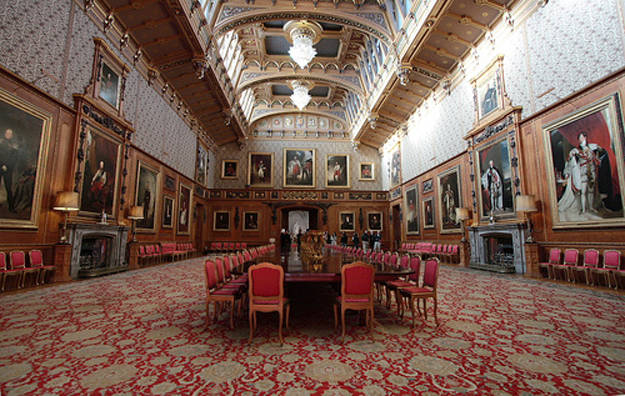
The Waterloo Chamber: Built to honor the defeat of Napoleon, this chamber was once an open courtyard. Today it holds many famous paintings, the largest known seamless rug in existence, and is used to stage concerts and other private performances.


[NB: This image is not mine!]

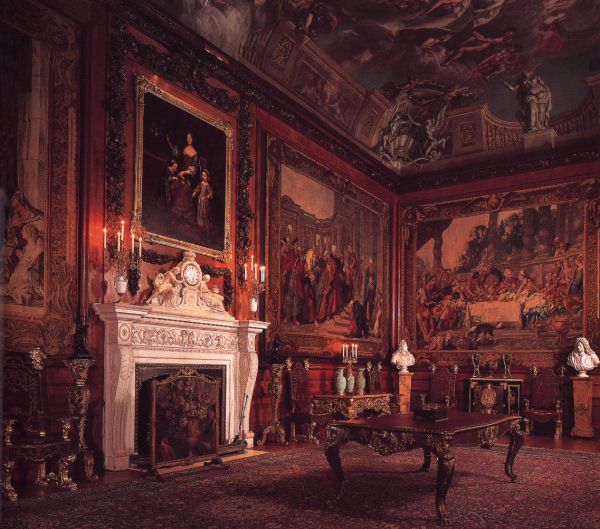
 The King’s Drawing Room: This room features many works of art, and a clock from 1730 that still plays music!


[NB: This image is not mine!]

 The King’s Bedchamber: Though there is a bed, the Sovereign does not actually sleep here. Rather, it is used for formal ceremonies (i.e., telling the King goodnight—formally—before he goes to bed elsewhere).


[NB: This photo is not mine!]

 The King’s Dressing Room: This room has served as both the Sovereign’s private bedroom and, later, as a dressing room. Now it holds a collection of Italian Renaissance paintings.


[NB: This image is not mine!]

 The Queen’s Drawing Room: Like the King’s Drawing Room, this chamber features many impressive works of art, including royal portraits of various Tudors and Stuarts. Also in this room is the famous Portrait of Charles I in three positions by Van Dyke. 


[NB: This image is not mine!]

 The King’s Dining Room: Located between the Queen’s and the King’s Apartments, the room served as the dining room for King Charles II.


[NB: This image is not mine!]

 The Queen’s Ballroom: As its name suggests, this long room was used for dancing (though I have a hard time imagining so many large gowns in such a narrow room!).


[NB: This image is not mine!]

 The Queen’s Presence Chamber and Audience Chamber:  The former is essentially an anteroom used by visitors before they are brought before Her Majesty in the Audience Chamber. (NB: Given that they are open to visitors, I doubt the current Queen actually uses these rooms for this purpose—though I could certainly be wrong!)


[NB: This image is not mine!]

 The Lantern Lobby: This room marks the spot where a private chapel once stood. It is also the spot where the 1992 fire broke out, which is commemorated with a large plaque.


[NB: This image is not mine!]

 St George’s Hall: This room is ginormous! At 30’ x 185’, this room is used for State banquets—a 175’ long dining room table is brought in which can seat up to 162 guests. There are also panels on the ceiling and elsewhere that are inscribed with the names of various knights. According to one source, the plain white shields mark Garter Knights were have been disgraced by crime or treason.


[NB: This image is not mine!]

 Also on display in St George's Hall is the black armor used by the King's / Queen's Champion from the time of King James I through George IV. It is this figure's role to act as the champion of the new Sovereign at their coronation, in the (unlikely) event of a challenge to the throne being issued. It was required of the Champion that (s)he ride, in full armor, into Westminster Hall during the coronation banquet and await any challengers. (NB: The Sovereign—by virtue of rank—could not face his or her challengers in single combat.) 

A purely ceremonial position today, Queen Elizabeth II's current Champion is Lieutenant-Colonel John Lindley Marmion Dymoke, Lord of the Manor of Scrivelsbry and the Manor of Telford—he acted as Standard-Bearer of the Union Jack at Her Majesty's coronation ceremony in 1953.


Moving on... since The Queen wasn’t in residence, we were also allowed to visit some of the...

SEMI-STATE APARTMENTS

These Apartments were created for King George IV in the 19th Century. Today, Queen Elizabeth II uses them for entertaining. These rooms are made up of the Green and Crimson Drawing Rooms, the State Dining Room, the Octagon Dining Room, the China Corridor, the Grand Reception Room, and the Garter Throne Room.

This last one is the one I’m most interested in. Before being converted, the Garter Throne Room was actually two separate rooms, the King’s Presence and Audience Chambers. Today, it is where The Queen conducts investiture ceremonies for new Knights and Ladies of the Garter prior to their installation in St George’s Chapel on Garter Day.


The Queen's throne is the white chair in the distance.
[NB: This image is not mine!]

Now, you may be asking yourself, ‘What is Garter Day, and who are these Knights and Ladies?’

Well, this is the highest order of chivalry that one can be invested with in England, and its doling out is entirely at the discretion of the Sovereign. Membership is limited to the Sovereign, the Prince of Wales, and no more than 24 others at any one time (meaning that new members have to wait an existing knight or lady vacates their position). The emblem is a blue garter with the motto ‘Honi soit qui mal y pense’ (‘Shame upon him who thinks evil upon it’) embossed in gold. The Order was founded in 1344 by King Edward III.

In addition to Queen Elizabeth II and Prince Charles, other current members include: Prince William; the Princess Royal; the Dukes of Kent, Gloucester, York, and Wessex; the Kings of Spain, Sweden, and Norway; the Queens of Denmark and the Netherlands; the Emperor of Japan; former Prime Ministers Margaret Thatcher and John Major; and Baroness Soames (the only surviving daughter of Winston Churchill).


[NB: This image is not mine!]
[NB: This image is not mine!]

 Well, that’s all that I have to say about the interior—especially since we (obviously) couldn’t visit the section cordoned off for the Royal Family’s private Apartments. 

(However, you can see them from the outside in the photos below of the Upper Yard. The wall farthest away is where the private Apartments are located, and the wall running along the right-hand side is for official guests of Her Majesty. The entrance seen in the middle is the exterior entrance to that section.)


I hope you’ve enjoyed this little play-by-play of my trip to Windsor, and that you haven’t minded too much my geeking out!

Until next time…

Monday, May 7, 2012

Strolling Through Southwark...


As I mentioned yesterday, I really plan to make the most out of my remaining time here—apparently, I was determined to prove that point by going all out today! And what an amazing time I had!

I kicked off today by meeting my friend BC for coffee at LJ’s. She and I first met during my trip to Morocco and, like me, she’s an American studying abroad (in Ireland). We spent about 2 hours, just catching up and chatting about the similarities of our experience over caffeinated beverages and ginger bread.

Eventually it was time to part ways and so, after bidding one another adieu, I set off on the rest of my adventure. I’ve been meaning to spend some time in the Southwark area since arriving, but time and energy have simply not been on my side. Determined to rectify this situation, I started walking in that direction from Soho. En route, I made a brief stop at Forbidden Planet, a comic shop I had spotted earlier but hadn’t had time to check out.

Oh. My. Stan. Lee!

In the first few minutes of being there, I had multiple nerdgasms! They had absolutely everything this geek could want: there was a diorama of Yoda’s hut (inside and out, and perfectly sized for the Star Wars toys); statues of various action heroes and villains; a wall of everything Doctor Who related; plush comic book characters and action figures; loads of Star Trek stuff; and, of course, actual comics, books, and related films. 

Being on a tight budget, I restricted myself to two items. One of these was the first book from the Game of Thrones series—I’ve caught up on the television adaptation, and cannot wait to find out what happens, so I’m going to read ahead. The second item I bought was a two-disk She-Ra, Princess of Power DVD set. It’s basically the same ‘Secret of the Sword / Best of…’ set that we got in the states, but what caught my attention was the cover artwork: the Sorceress of Castle Grayskull was on there. Based on that alone (well, that and the £4 pricetag), I knew I had to have it! Imagine my further delighted surprise then, when I opened the pack and found that the disk images were the Sorceress and Shadow Weaver—my two favorite POP characters! #YAY!


Eventually I pulled myself away from Forbidden Planet, and resumed my journey to Southwark. 

Ultimately, I decided to go by the Tate Modern finally. Now, I should preface all of this by saying that I’m not the world’s biggest modern art fan. In fact, I’m not even the world’s biggest tepid modern art fan. Bottom line: I’m not a fan. But, I knew that I had to give it a shot, as the Tate Modern is one of the most famous art museums in existence. 

Gettin' my modern on...

I confess to enjoying it more than I expected to. The Powers that Be do a really good job of curetting the exhibits—for the most part, it’s really accessible, and ‘they’ provide the necessary historical and artistic insights that make these works of arts understandable to a wider audience. In doing so, they challenge the typical, alienating sense of religiosity and awe contained in most museum settings. I'm a huge fan of this demystification process!

The only downside is that this encourages people to bring their children. Not only is this inconvenient due to their sticky fingers and high-pitched squeals but, also, there’s nothing quite as awkward as realizing that a three year old is staring at you as you admire Paul Delvaux’s ‘Sleeping Venus’ in all her naked glory—‘cause you just know that little brat thinks you’re looking at Venus’ prominently displayed no-no parts when, in fact, you’re attention is drawn to the chick with the fierce red hair who looks like she just stepped out of a Tim Burton film about drag queens. 

But I digress…

There were a couple of pieces I enjoyed, the aforementioned being one of them. Another was Do Ho Suh’s Staircase-III. I was amazed at how detailed it was—including ‘simple’ details like light switches made out of fabric—and how this piece made me feel like I was in some weird dreamlike state. In hindsight, I really regret not getting a photo of it. (A second trip might be required at some point solely for that reason.)

Another work I want to mention, which I enjoyed seeing mostly for the spectacle, was the notorious Damian Hirst’s ‘For the Love of God’ (a.k.a. the crystal skull piece). For those who aren’t familiar, 

For the Love of God is a life-size platinum cast of an eighteenth century human skull, covered by 8,601 flawless diamonds, inset with the original skull’s teeth. At the front of the cranium is a 52.4 carat pink diamond. Since it was first exhibited in 2007, For the Love of God has become one of the most widely recognised works of contemporary art. It represents the artist’s continued interest in mortality and notions of value. Alluding to the iconography of the skull in art as a memento mori—a reminder of the fragility of life—the work can be viewed alternatively as a glorious, devotional, defiant or provocative gesture in the face of death itself. (Tate Modern website)

'For the Love of God' [NB: This image is not mine!]
 
 Now, I’m not here to get into a whole debate about Hirst and his art—I don’t know enough about the man or the topic to do so. That being said, I confess to liking this piece. And it’s for the same reason I like some of his other work that I’ve seen photos of, and even the earlier-mentioned ‘Sleeping Venus’: 

I like my modern art grim. 

You see, I realized today that I’m much more willing to give modern art a chance if it’s filled with dark colors and abject(ified), Gothic imagery. If it’s all simple geometric shapes with no purpose, pained in neon oranges and pinks and yellows, then I want nothing to do with it. Give me depictions that tell a story—about death, or about how shit this life can be sometimes—with dark blacks, and blues, and purples. That, I can appreciate.

But I’ve gone on enough about art. I did a lot more today than just that!

After leaving the Tate, I continued eastward along the Thames, passing the (rebuilt) Globe Theatre along the way. Eventually, I reached the Clink Prison Museum. Nic and I caught a glimpse of this place when we were here back in 2008, but we weren’t able to go in for one reason or another (I think we had tickets to do something that night). I knew that I just had to go there this time.

The Clink is a subterranean prison that was in operation from c.12th Century until 1780. The origins of its name have been lost to time, but it has been speculated that the sound comes from sounds of chains being affixed to prisoners—furthermore, it is from this notorious gaol (jail) that the slang term ‘the clink’ came to symbolize modern jails.

Undoubtedly arrested for public drunkenness...

It’s reputed to be haunted, though I didn’t see any ghosts. Honestly, I was kind of underwhelmed. However, it was pretty interactive—I was able to handle actual (reproductions) of torture devices that were used—and I did learn some new things, too. 

For instance, another common prison-related term used today—‘the hole’—can be linked back to the Clink. Except, rather than being solitary confinement (as we might understand it today), this was literally a hole that prisoners were shoved into and forgotten about. 

At high tide, the polluted water from the Thames would fill the hole almost completely, but not enough to drown (most of) the prisoners—instead, they succumbed to either hunger or various diseases they contracted from the water (e.g., Dysentery). It was also not uncommon for prisoners in the hole to become so waterlogged that their skin would literally begin to rot while they were still living. Terrifying!

The Hole! (You can't see it here, but the pit is filled with water.)


After touring the Clink, I climbed back up to the street level and started toward my next destination. I wrapped around the Golden Hinde, crossed London Bridge (which thankfully did not fall), passed the Monument to the Great London Fire of 1666, and finally arrived at St Paul’s Cathedral.

I arrived in time for the Evensong Service, which meant that I didn’t have to pay to get in (the main reason I hadn’t visited prior). I was able to go in and look around a bit, but there wasn’t really anything interesting that caught my attention. 

Don’t get me wrong: it’s absolutely gorgeous inside, and reminded me of so many pictures of the Vatican that I’ve seen over the years. Everything was a crisp white, glistening gold, or polished onyx—a far cry from the stony interior of Westminster Abbey, for instance. Nonetheless, I just didn’t have a desire to stay, and so I sneaked out before the service started.

St Paul's Interior

 From there I made my way through Trafalgar Square—passing the Royal Courts of Justice en route—and down to the Horse Guards Parade and Whitehall / 10 Downing Street

Regarding the former, today this is where the annual Trooping the Colour ceremony—which officially marks the Sovereign’s birthday—takes place, but in the past it was used for other events as well (e.g., jousts held for King Henry VIII). 

The latter site is the home of Britain’s Prime Minister. Sadly, you cannot see his exact residence from the road—the gate at the edge of the street is as close as you can get.

And, finally, I concluded my day by taking a brief stroll through St James’s Park, where I once again snapped lots of bird photos. But I also did this for another reason: for myriad reasons, I’ve found myself in St James’s Park about once a month throughout my stay. The photos I’ve taken there somewhat show the changing of the seasons, and will serve as a nice, overarching reminder of my time here.

St James's Park with Buckingham Palace

Okay, it’s late and I’m exhausted—and no wonder: GoogleMaps tells me I walked over 8 miles today—time to wrap this up! 

Today's Trip

Until next time…