Showing posts with label Culture Power and Resistance in the Twenty-First Century. Show all posts

Sunday, May 6, 2012

Thirty Days Left...


Thirty days. 

As of today—6 May 2012—that’s all I have left of my time in London. As usual, I’m behind with this thing, but didn’t want this milestone to pass by without saying a little something about it.

All in all, this timeframe marks the beginning of a period of transition—things here draw to a close, as I begin the trek back to my own weird version of ‘normality.’ And it’s not just the big things that are concluding, like my semester as a University of East London student. It’s also the little things, like the huge canister of coffee I’ve used throughout most of my stay finally drying up (the day after classes ended, ironically). Let’s ignore the coffee for a second, though, and look at my time as a student instead. 

UEL Docklands Campus

 Because the US Olympic team will be staying in UEL’s dorms, the entire semester calendar was out of whack. Basically, we turned in midterms, had two weeks of Easter Break, one week of classes, and then our finals were due. 

It was a whirlwind, crazy experience—and if you’ve been following me on Facebook, you know the experience was both taxing and moody-making. Nonetheless, I persevered, and in the end I think I handed in three strong final works.

Most likely, I won’t know how I did on those final projects until I’m back home, but I can talk about how I did on my midterms, as well as offer some final feedback on my experiences in the corresponding modules:

‘Cultural Politics: Power & Contemporary Social Change’ (CC1202; you can find the module description here): Though it served as mostly a refresher course for me, I did enjoy this course quite a bit. The instructors, SM and DS, were my favorites, and really knew what they were talking about. Also, I walked away feeling like I had a much better understanding of Marx—though I still prefer Foucault for his focus on questions of identity.


My CW1 (midterm) assignment was, literally, just the first draft of my final piece. A reflexive work, it explored gay men’s participation in the act of marthoning/triathloning as a form of body-modification and self-surveillance (in the Foucauldian sense) rooted in the discourse of HIV/AIDS and the idealized (gay) male form. On CW1 I scored First-Class marks (the equivalent of an ‘A’), and the assessor’s feedback listed my work as 'a very substantial and scholarly case study that uses excellent examples.’ Based on the early feedback I received on CW2, I’m fairly confident that I’ll receive First-Class marks on the completed work as well.

‘Realism, Fantasy & Utopia’ (CC2202; you can find the module description here): Whereas DS was the co-instructor in the aforementioned class, this module was solely hers. And it was amazing—by far, it was the most brilliant of the courses I took at UEL. My love of this class was not solely based on our phenomenal guide, however—equal credit goes to the amazing friends I’ve made therein, amongst them TvH, RAS, SV, and AR! 

As far as my midterm goes, I also received First-Class marks on this one. It was a rather easy assignment, wherein we merely had to explain the concepts of realism, fantasy, and utopia. As a funny aside, one of the critiques DS offered of my work was that she felt I was too quick to privilege the perspective of the artist/author—she and I have subsequently agreed to discuss this further, as this is an argument I tend to get into with everyone. I strongly feel that too much credit is already given to the reader, and that rather than privileging either the author or the reader, one needs to pay equal lip-service to both perspectives. After all, to overlook the author’s intent de-historicizes and depoliticizes the work. 

Based on the early feedback I received on my final essay—a critique of American Horror Story as a heteronorm-affirming Gothic text—I think DS and I are much more in-sync this time around. This second piece was approached from a Feminist and Queer theory perspective, and DS seemed really excited when she read the draft version. I’m hoping for First-Class marks on this essay and, with her help, I’m hoping to submit it to the Watercool Journal for publication—if accepted, that would be the second piece I’ve had electronically published in a peer-reviewed journal!


‘Culture, Power & Resistance in the 21st Century’ (CC3202; you can find the module description here): By far—by leaps and bounds, and fathoms and light-years—this was my least favorite of the three classes. The instructor was highly disorganized, often came across as condescending toward me, and lacked time-management skills. I highly recommend that Columbia students do not take this class. 

As a result of myriad problems I had in this class—which, to be completely fair, included the resistance I developed after one too many failures to meet what I consider good teaching practices—my CW1 assignment from this class only garnered a 68 (i.e., ‘B’ / 2.I classification). I don’t hold out hopes for a higher score from my CW2 assignment, as the instructor replied with his feedback right before the deadline—5 full days after the date he agreed to. Fortunately, I suspected something like that might happen, and so I asked DS for feedback as well. With her help, I was able to turn my work into something that should at least enable me to pass the class.

Overall, my experience with UEL was a good one. I definitely miss my home-uni, despite it’s countless problems—and I definitely miss CCC’s technology infrastructure, ‘cause UEL’s is atrocious—but the University of East London has been a nice classroom-away-from-home, and I will be eternally grateful for this amazing opportunity! 

So, what now?

Well, as I noted earlier, it’s a time of transition. The biggest thing on the horizon once I return to Chicago is my participation in the Chicago Marathon (26 miles). Given that I’ve never run that distance before—in addition to triathlons, I’ve only ever done a half-marathon—I’ve had to start training here. Yesterday I went for my first 3 mile run of the season. It wasn’t bad, but it was a bit chilly—9˚C/48˚F, with a cold drizzle—and a bit slower than I wanted. Ah, well. By the time I return to Chicago on 5 June, I’m supposed to be running 7 miles.

Speaking of the marathon, I should probably take a brief second to tell/remind folks why I’m doing it. You see, for the third year in a row, I am part of the amazing Team to End AIDS (T2) but, this year I’m putting my bike and wetsuit aside, and solely workin’ the running shoes! (Get it? ‘solely’ and ‘running shoes’? It’s a shoe-joke.)

Take a moment to watch this short video, as it tells you a little more about the journey I'm about to embark upon:


However, in order to train with T2 I have to raise (a minimum) of $1200 by July 1st for the AIDS Foundation of Chicago (AFC). HIV/AIDS continues to be a very real problem today, even though it’s not always talked about in the US. In fact, every 9 1/2 minutes someone in the United States is infected with HIV, and each year people grieve for loved ones whose lives have been claimed by the disease. Fortunately, AFC—which was founded in 1985 by community activists and physicians—is leading the fight against HIV/AIDS, and striving to improve the lives of people in the Chicago area who are affected by this pandemic. By funding prevention programs and vital services such as medical care, food and housing, AFC works to stop new infections while helping to keep people with HIV/AIDS alive until the day there’s a cure.

So here’s the skinny:

On top of wanting to overcome a new physical challenge (and achieve a fit-in-the-British-sense body), I desperately need help in raising $1200 for the AIDS Foundation of Chicago this year. As of right now, I only have $540 to go! Not only will sponsors be joining me in the fight against HIV/AIDS, but they will also be supporting me in the pursual of a personal goal that—even a year ago—I never considered possible.

All one has to do is visit my fundraising page and click on the ‘Sponsor Me’ button in the upper left-hand corner (or, if interested in making alternative payment arrangements—which includes sponsorship by volunteerism—just let me know). Any and all donations are appreciated, including those from people living outside of the U.S., and they’re tax deductible to boot!


AC, JD, AT, Nic, and Me after completing the 2011 Chicago Triathlon with T2.

Other than that, the plan is simply to make the most of my remaining 30 days abroad. 

I’ve certainly already started in regards to celebrating my time here—a certain less than stellar photo of me drinking a Mojito out of a suitcase attests to that (thanks, TvH and LD). But I’ve got some other things planned too. For instance, on Wednesday I’m going to go watch as The Queen and Duke of Edinburgh make their way to Westminster for the State Opening of Parliament. Also, I’m meeting my friend BC—she and I met during my trip to Morocco—for coffee tomorrow morning. And, finally, I’ve officially scheduled my final international sojourn during this trip: I’ll be going to the Netherlands (Amsterdam) from 13-16 May, and since I’m going by bus(!) I’ll have a chance to see the northern part of France and Belgium as well!
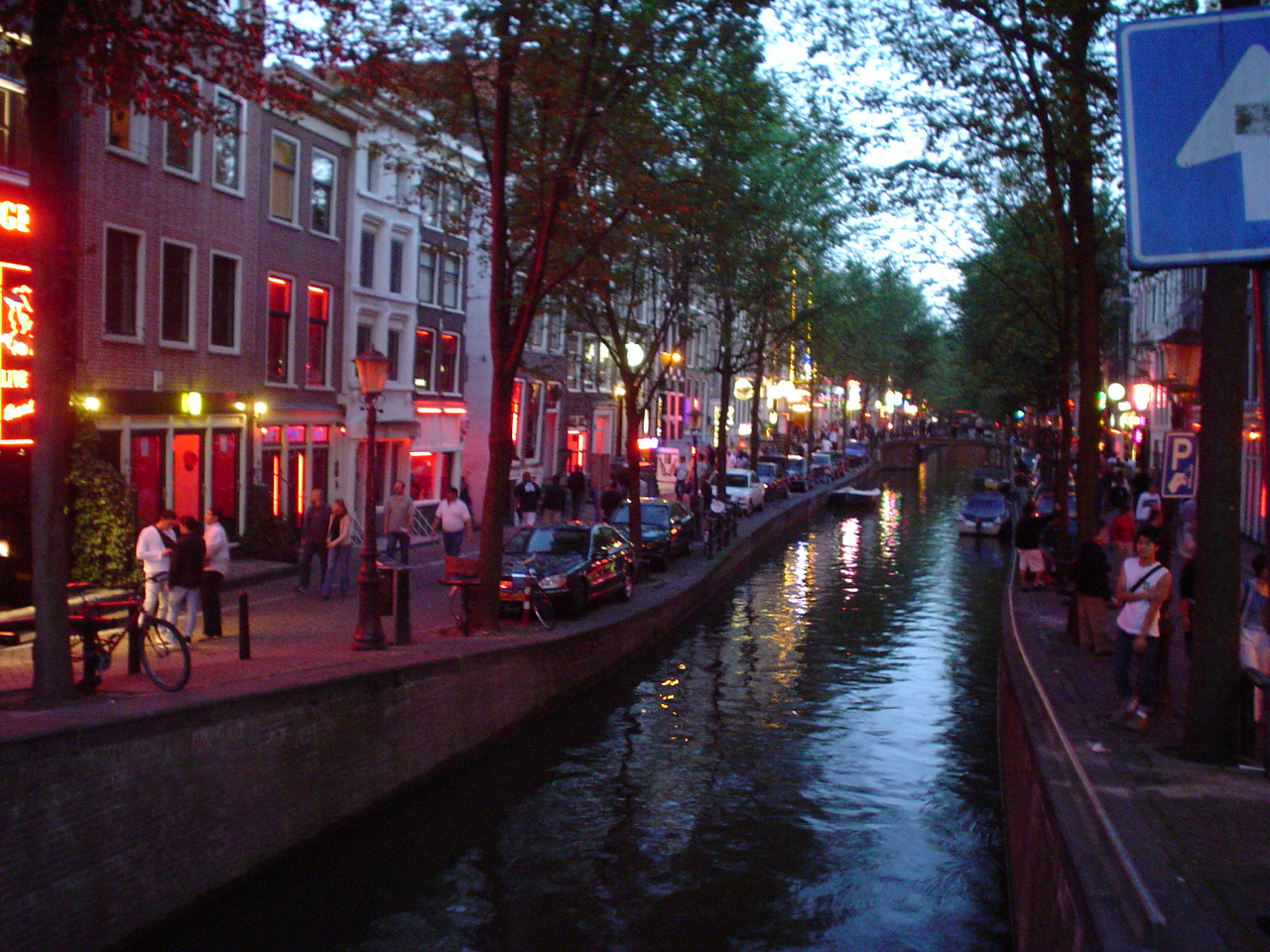

Amsterdam's Red Light District. [NB: This photo is not mine!]

Oh, yes, the next few weeks will be very exciting!

Sunday, April 29, 2012

What's Curry Got To Do With It?


I’m back with another entry. Truth be told, everything I’m about to say deserves a lot more ‘oomph’ than what I’m about to give it—but, I’ve spent most of the last two weeks (including most of yesterday and today) writing about discursive representations of the intersection between gayness and AIDS as part of two separate final projects. 

In other words: my brain is so far beyond mush that words do not even exist to describe it.

Nonetheless, there’s a lot that I haven’t blogged about this month, and I’m feeling a lot of pressure from ‘Future Brett’ to document it all in one form or another while it’s relatively fresh in my mind. Thus, I offer the explosion of information presented here. 

Let’s get started, shall we…

On Sunday, 15 April, I accompanied EN to a theatre performance she’s been interning with throughout the semester. The show is called Soul Sister, and is the story of Tina Turner’s relationship with Ike, as told by the former while backstage during her ‘Private Dancer’ tour. 


Most people already know the troubled tale of Ike and Tina Turner, so I won’t go into that here (though I will say that the first act in particular was far more forgiving of Ike than I expected). Instead, I want to focus on two particular aspects of the show: the actress playing Tina, and the ending:

The role of Tina was given to Emi Wokoma (who, ironically, played the sister of Tameka Empson’s ‘Kim’ on EastEnders). The Guardian reviewed Wokoma’s turn as Turner thusly: 

[Wokoma’s] impersonation of Anna Mae Bullock, renamed Tina Turner when she started singing with Ike Turner, is startling. She's got that strange, stiff-legged dance – the one that looks like a man who's left the urinal too soon – and the flutters of the hands. And she's got a voice that can strip paint or sing a lullaby within the same bar. (Soul Sister Review)

I admit that I was a bit concerned with Wokoma at the start. The opening number is ‘Private Dancer,’ one of my favorites. Wokoma’s rendition wasn’t bad by any stretch of the imagination, but it also wasn’t great—I felt as if she wasn’t warmed up yet. Fortunately, after that number, the songs performed are basically in chronological order, and follow Anna Mae’s rise to prominence. This gave Wokoma the chance to warm-up her Turner impression, as her character also developed her unique style. By the time ‘River Deep, Mountain High’ was performed, audiences could be easily excused for forgetting that the real Tina wasn’t on stage.


[NB: This is not my photo.]

This brings us to the other point I wanted to bring up about the show: the ending. As previously noted, the story is told from the point-of-view of Turner, who is relating events to a friend backstage between sets. Upon concluding her tale, Turner returns to her (fictionalized) concert—whereupon the theatre audience becomes a concert audience!

The last 15-20 minutes of the show is just like a traditional concert. There is no narrative: just Wokoma—accompanied by a band, backup singers, and flashing laser-lights—recreating Turner’s early-80s comeback tour. Traditional Tina favorites—such as ‘Simply the Best’, ‘I Can't Stand the Rain’, ‘Help’, and, of course, ‘Proud Mary’—drove audiences to their feet. No lie. There were even encore songs, in true concert style: ‘Steamy Windows’ and ‘What’s Love Got to Do With It?

‘Awesome’ doesn’t even begin to describe the experience. All I can say is that if you’re in London, and are even remotely a Tina Turner fan, you must see this show!

After Soul Sister, EN and I were ridin’ high, as concert goers typically are right after a show lets out. So, we headed over to Soho and a bar there called 79CXR. This particular bar was billed in one of the local rags as offering gay karaoke, and we thought it might be fun to check that out. 

I’d say we had a decent time: drinks were cheap even if the singing was painful. Also, it wasn’t crowded—almost always a perk. When the karaoke wrapped-up at around 9:00 PM, Bette Rinse (the drag queen emcee) organized a group of fellow queens and locals for a queer version of ‘Match Game.’ Sadly, it was all a bit lost on EN and I, as neither of us were familiar enough with the local drag scene to get the references to specific community members. Ah, well. It was still interesting.

Okay, I’m going to totally change topics now. (Like I said, there’s a lot to catch-up on!)

On Thursday, 19 April, two of my friends from Chicago—TS and his partner, BH—flew in to London for the latter’s birthday weekend. I was fortunate enough to see them on three of the four days they were here.

That first day (Thursday) was a bit rough for me. I didn’t sleep well the night before, and had zero desire to go to school that morning. Nonetheless, I made the long slog there…only to learn that one of my two classes that day had been cancelled. Now, this isn’t a problem in-and-of-itself. The class in question is my least favorite (‘Cultural Power & Resistance in the 21st Century’—not nearly as interesting as it sounds). Nonetheless, the scheduled lecture for that day would likely have been beneficial for my final essay. Ah, well. Then, as if that wasn’t bad enough, I got caught in a downpour on my way home. I. Was. Drenched…and unhappy. 


Unhappy and Soaking Wet.

Fortunately, seeing two familiar faces was just the boon that my spirits needed. We headed into Soho to grab a couple of cocktails at Village, and from there we went to Maison Touareg for dinner. I was uber-excited for this, because I had wanted to check out Maison Touareg since coming back from Morocco, and was merely waiting for the right ‘excuse’ to do so. It was sooooo delicious! Wonderful company was made even better by amazing food and wine. My only complaint is that we were seated beneath the speakers, and the music grew a bit loud when the belly-dancer (whose skills were mostly lost on us) came out. Other than that, it was perfect!

Friday, 20 April, marked the last official day of classes at UEL! My exams aren’t due until this week, but classes have concluded. As my Friday class (‘Realism, Fantasy & Utopia’) was my favorite, this was a bit of a bittersweet moment. I’ll talk more about all that in a later entry, though. After class, I returned to my flat, where my housemates were already in weekend-party-mode. Ugh, it was so loud! For the second day in a row, I found myself highly agitated.

Fortunately, TS and BH invited me to join them once again! This time we went to Cinnamon, an Indian restaurant near Oxford Circus. Once again, I had an amazing time! The food was good (albeit a bit spicy): we shared a plate of ‘BALLS!’ (as listed)—potato, beef, vegetable, and Bangla-Scotch egg—and for the main course I ordered a plate of ‘Old Delhi-style tandoori fenugreek chicken’ (whatever all that means). 

Even better than the food, though, were the drinks. I stuck to water (I had to be up early the next day), but I did have a sip of both TS’ and BH’s drinks—if anyone’s interested, Cinnamon offers the best mojito in the history of forever. After dinner we headed over to the Duke of Wellington (another gay pub) for a last round of drinks going our separate ways.

I’m going to skip saying anything about Saturday, 21 April, as that will get its own entry owing to a trip to Windsor Castle. As for Sunday, I had one last opportunity to see TS and BH before they headed back to Chicago. We met for bagels and coffee at Beigel Bake in Shoreditch. Apparently, this is the oldest bagel place in London. It’s also one of the cheapest places I’ve been in London—but so worth it! I got an éclair (how could I resist?), and it was one of the most scrumptious sweets I’ve eaten since being here! Yummy-yummy! From there, we walked over to Old Spitalfields’ Market, where we walked around for a few minutes before bidding on another adieu! All in all, it was a wonderful visit, and so nice to see friends from home! 

And, on that happy note, I will also say farewell to this entry. I’ve finally gotten ‘Future Brett’ off my back for a bit, and can realx…for now—there’s still a lot to tell about, including my trip to Windsor, the results of my midterms, and my hurried escape from my flat!

But that’ll have to wait a bit longer…

Saturday, March 24, 2012

Casual Over-Drinks Topics...


There’s not too much to talk about at the moment, but I figured I should do a quick entry just to highlight a couple of things that I’ve done over the last week.

Tuesday night (20 March) I traveled to Leytonstone—birthplace of Sirs Alfred Hitchcock and Derek Jacobi—in order to meet-up with two UEL students, JA and GC, for drinks. The peers in question are both thesis-level Cultural Studies students who occasionally pop into my horrid ‘Culture, Power and Resistance in the Twenty-First Century’ class. One of them (JA) also happens to be the UEL student that came to Columbia last year. We met up at the Red Lion (which I think might be affiliated with the pub I went to with K&M on my second night here), and spent a lovely couple of hours catching up over beer and cider. We chatted about everything from white privilege and racism in Europe, to the failings of abstinence-only education in the U.S., to the attempted privitization of England’s healthcare system. You know, casual over-drinks topics…for Cultural Studies students at least.

Tuesday night wasn’t my only stab at being social this week. Last night (23 March) I happened to catch a Facebook update from another friend, AH, that he was stuck at Victoria Station, waiting for a train to take him back home (which is about an hour away). Now, I’ve ‘known’ AH online for around 13 years—we’ve been part of the same He-Man/She-Ra community since the mid- to late-1990s—but we’ve never actually met before. (Namely because of the ocean which separates us.) So, upon spotting this update, a hurried flurry of messages were exchanged, and plans were made to finally meet up in person while he waited for his rescheduled train. A short while later, and we were finally greeting one another face-to-face.

Me and AH at Victoria Station

Since AH had a couple of hours before his train was scheduled to depart, we nipped over to the Duke of York, a pub not far from the station. This was actually my first experience meeting another He-Fan/She-Raver in person—everyone’s so spread out in the States that it’s hard to do so—and I loved every second of it. It was so surreal: two grown, 30(ish) year-old men—in a dark, noisy bar surrounded by stumbling heterosexuals trying to dance to ‘Hot in Here’ (and the men suggestively removing their suitcoats)—talking about everything from the father/daughter relationship between Hordak and She-Ra, to what kinds of material the Four Horsemen will use to design Scorpia’s tail, to the role of the Filmation series in producing a generation of really swell, inclusivity-minded people. You know, casual over-drinks topics…for He-Fans/She-Ravers at least.

Beyond those two bits of excitement, there’s really not too much else to tell. This week’s kind of flown by (and, honestly, I wish it would slow down)! I’m housesitting for K&M at the moment, and keeping their delightful dog Bowmar company. I’m loving every second of the peace and quiet here. I hadn't realize how stressed out I’d become living in the other house until I came here, but I suddenly find myself very relaxed.

Of course, part of the stress I’m feeling might have more to do with midterms than the constant thumpa-thumpa at my flat. Basically, our entire grade comes down to two grades: our final (60%) and our midterm (40%). Oh, and they do not award 100% over here, the rationale being that if your work warrants 100% then you should already be a teacher. Realistically, the highest score most students earn is about 75%. So, basically, my midterms have to be spot-on if I want to try to maintain my 4.0!

Fortunately, midterm madness is almost over. One of them (‘Realism, Fantasy & Utopia’) was due last week, and the other two are due this week—followed by two glorious weeks of Easter Break (yes, it's called Easter Break here), during which time I hope to visit Scotland!!!! 

And then we go straight into working on our finals, because there's only like 5 weeks left of the actual semester following Easter Break.

Two final things I want to mention, but which don’t really fit anywhere else:

First, yesterday was a gorgeous day! Mind you, this is still London, so of course there was a curtain of smog blanketing the skyline—I have yet to see a day that is both sunny and clear—but I’ll take what I can get! It was simply too nice restrict myself to the indoors all day, so after class I ran to K&M’s house, spent some time with Bowmar, grabbed the laptop, and headed to a coffee shop in Soho. The place was called LJ’s CoffeeHouse, and my choice to go there was pretty random: I simply wanted somewhere that was open-air and had free wifi, and this is where Google directed me. After visiting their website, however, I also became smitten with LJ’s through the following ‘prayer’ posted on their site (and which I can totes relate to):

Caffeine is my shepherd; I shall not doze.
It maketh me to wake in green pastures:
It leadeth me beyond the sleeping masses.
It restoreth my buzz:
It leadeth me in the path of conciousness for its name's sake.
Yea, though I walk through the valley of the shadow of addiction,
I will fear no equal.
For thou art with me, thy sweetness and thy crema they comfort me.
Thou preparest a carafe before me in the presence of my barista:
Thou anointest my day with pep; my mug runneth over.
Surely richness and taste shall follow me all the days of my life:
And I will dwell in the house of LJ's forever.

The service was only decent (though very friendly), but the coffee and the atmosphere as a whole were excellent. The gay Sohoians seemed to come alive, renewed by the sun’s warmth. People were so happy and pleasant, and it all jived perfectly with the mood I was in. (It was not, however, conducive to working—I spent 90% of my time there just chatting with Nic over the interwebs.)

Secondly—and containing spoilers (consider yourself warned)—I was saddened to learn on Thursday night that ‘Eastenders’ had killed off one of my favorite characters, George-Michael-obsessive Heather Trott (Cheryl Fergison). Alongside the Dot, Kim, and Shirley characters, Heather was one of my favorites. And the way in which she died—and the status of her relationships with best-friend Shirley and her murderer at the time—is just too sad. And sadly, it seems as if the U.K. soaps don’t bring back characters from the dead in the way the U.S. soaps do. Ah, well—I’ll miss you, Heather, but at least I can find some of your shenanigans on YouTube still: 


Until next time…

Tuesday, February 7, 2012

The Iron (Yet Oddly Infirm) Lady...


So, I just finished watching Meryl Streep in “The Iron Lady.” 


As always, I cannot say enough good about the divine Meryl Streep—I have loved her performances in practically everything she’s done, and this is no exception. Indeed, her physicality in “The Iron Lady” made me honestly forget from time-to-time that she was not an 86 year old woman.

Yet, regarding the movie itself, I cannot help but cry out: “You’re a walking lie; and I can see right THROUGH you!


Please note that I’m about to start discussing spoilers from the film, so, if you haven’t seen it yet, you might want to avoid the rest of this post…


“[Margaret Thatcher] made popular a host of right-wing prejudices and homilies such as comparing government expenditure to household spending, and denying the logic of Keynesian economics, stating that governments could not spend their way out of recession...Across the Atlantic, Ronald Reagan used a similar, simple language to mark a new era of government. Each sought to reconfigure the state, getting out of welfare and macroeconomic management while pouring public resources into defence, security and foreign affairs.”  ~ Gerry Hassan and Anthony Barnett, Breaking out of Britain’s Neo-Liberal State (2009)

There are two different stories being told in “The Iron Lady:” 

The first story—and the one I feel the creators want us to pay closest attention to—is that of an older woman. In the here-and-now (2011), she is seen as merely a shadow of her former self, plagued by dementia and grief-stricken over the loss of her husband (Denis) some eight years prior. This woman’s worried daughter (Carol), personal assistant(?), and absentee son (Mark) all conspire to keep her—once Britain’s first female Prime Minister—out of the public eye, while the ‘ghost’ of her dead husband follows her around and reminds her of bygone moments in her life.


The story of an older woman...


The second story—the ‘B-story,’ if you will—is more-or-less that of Margaret Thatcher’s political career. It follows her inculcation in conservative politics through her father (a lapsed liberal, more or less), touches upon her time at Oxford (where she met Denis), and glosses almost entirely over her time as a lawyer, an MP, Education Secretary, and Leader of the Opposition—i.e., approximately 26 years of her life. 

What we instead receive is a rose-colored—no, I won’t go that far—salmon-colored version of Thatcher’s time as Prime Minister. Audiences receive glimpses of the troubling Brixton Riots (1981), the divisive and socially-explosive miners’ strike (1984-85), and even a somewhat longer look at the militarized re-occupation of the Falklands (1982). But, by the end, these issues are set aside and audiences are nonetheless still left with hints at economic prosperity as a result of Thatcher’s “hard medicine,” neoliberal policies.


Thatcher (Streep) approaches No. 10 as Prime Minister

“…the core twin principles of Thatcher’s regime: the intensification of centralised executive authority and the cultivation of an elite order at ease with a politics focused on winners, wealth and corporate logic—a neo-liberal regime.” ~ Gerry Hassan and Anthony Barnett, Breaking out of Britain’s Neo-Liberal State (2009)

Okay, so just like there are two stories going on in “The Iron Lady,” I have two reactions:

My first reaction: If I allow myself to parse-out the narrative about the older woman coping with loss and our cultural treatment of the longer-lived* (thereby eliminating the problems of Thatcherism all together), then I have to say ‘kudos’ to the creators for a decent effort. 

The opening scene in the convenience store represents our collective intolerance, and the invisibility of the aged (especially women). Likewise, the scenes with the older woman’s children and assistant demonstrate the way we infantilize those of an advanced age because we assume they are mentally deficient and incapable of taking care of themselves—’cause, God knows, we can’t be bothered to actually talk to them, and find out what they’re thinking and feeling! 


He cuts her off without even seeing her...

In essence, “The Iron Lady’s” primary narrative showcases our cultural view of the elderly as a problem that we don’t quite no how to deal with (and so we don’t). Nonetheless, in the end, the film’s creators problematize that cultural assumption by having the older woman take a dose of her own “hard medicine” and send her husband’s ghost packing—literally!—thereby challenging the audience’s assumptions about her ineptitude and feebleness. 


Denis is sent off...

My second reaction: By juxtaposing Thatcher’s pernicious premiership against the dominant cultural assumptions UK/US cultures makes about longer-lived women, the film’s creators have attempted to make Thatcher’s actions (and, by extension, her neoliberal policies) seem relatively non-threatening in the grand-scheme of things. 

Similarly, by playing to ideologically-rooted—and emotionally-ladden—myths of (grand-)motherness, as well as our collective sympathies (to the extent that they exist) for the mentally infirm, audiences are left actually rooting for and excusing the actions of a woman whose tenure in office was marked by greater attention to corporate interests than the proverbial ‘little guy.’


(This is not to say that I was so distracted by such coded messages that I fell fully into the creators’ trap; but, I confess, there were times where I found myself thinking “Aww, she wasn’t so bad, really”—at which point I would promptly slap myself in the face and come back to my senses!)

So, yeah: all-in-all, there were definitely some problems with “The Iron Lady.” 

Was it worth watching? Sure. I’m a huge Meryl Streep fan, and I cannot deny that she does a remarkable job assuming the role of former PM Margaret Thatcher. Also, the makeup was superb, and what I have referred to throughout as the ‘A-story’ is very (bitter-)sweet. 


Thatcher at the Doctor's
 
I would simply caution viewers to be careful that they don’t get so swept-up in our society’s culturally-rooted ideas about age, gender, and disease, that they forget the social- and economic-reality of Thatcher’s problematic premiership.

* I think I’m reasonably safe in assuming that today’s British culture treats longer-lived persons in roughly the same way as modern US American culture.

Saturday, January 28, 2012

The Classes...


Happy weekend, everyone!

Well, classes started for me this week. Since that’s the main reason I’m in London, I should probably say something about it, don’t you think? So, below I’ll provide an initial glimpse into each of the modules (courses) I’m taking. No other updates in this post—I'll create a separate post for that stuff in a bit. 

In the meantime:

“Cultural Politics: Power and Social Change” (Thursdays; 9:00 AM-12:00 PM GMT): This module is one of the ones I was required to take—it’s the equivalent of a first-year, post-introductory course. Co-taught by SM and DS,

“[t]he aim of this module is to introduce key ways of understanding power and the technologies through which it is expressed and distributed, and then to put these theoretical ideas into practice by analyzing contemporary instances of cultural politics.

Our interest throughout will be with the question of cultural change, and the possibilities for resistance.

How does change take place and what is the role of technologies in social change? Who has power in our cultures and how does it work?

At the end of the module you will be expected to have an understanding of the different ways in which key theorists in Cultural Studies have understood power and its origins, and be able to undertake different kinds of analysis of cultural politics.” ~ module guide (a.k.a. syllabus). 

As I noted above, it’s fairly similar to a first-year course, and there are the obligatory readings form Gramsci, Althusser, Foucault (YAY!), and Marx...

I love Michel Foucault!
______

Now, let me digress (read: rant) for just a moment about that reading list:

I loathe—positively detest; hate; venomously dislike; would rather have a root-canal—reading Marx! Don’t get me wrong; I don’t have a problem per se with what he’s saying. I just hate READING his work (well, the English translations at least).

In some ways, Marx is almost like Tolkien, in that he takes four or five pages to spit out an idea that could have been said in one very short, very concise blurb. And, what’s worse, whereas Tolkien was at least describing ostensibly epic scenery—something to spark the imagination—over those many, many pages, Marx goes on-and-on about labor and value and commodity. Since such matters are already something I’m not overly interested in analyzing personally, the excessive page-counts that are part-and-parcel of Marx-related readings does not make me like him any more. (NB: I'm not saying the issues Marx raises aren't important issues to be explored—they're just beyond my ability to analyze.)

And, finally, I just have to say that, personally, the readings during the first two or three weeks of Cultural Studies-related classes are always my least favorite. Why? C’mon, surely you’ve guessed by now—it’s because they’re always related to Marx! As much as I love and respect my CS instructors, I think there’s a stipulation in the contracts they sign—both in the US and the UK, apparently—that they must all devote the first few weeks to my German foe. (Not that I wish to see him eliminated from the curriculum altogether, of course—it’s just that, if I had my druthers, someone more exciting, like Foucault, would come first.)

Alas, it appears I've taken a page from one of his manuscripts, and written too much. Let me put it this way: this is what my brain feels like after reading Marx...


End rant…

______

My second class:

“Culture, Power and Resistance in the Twenty-First Century” (Thursdays; 1:00 PM – 4:00 PM GMT): This is the only class I’m taking that wasn’t required by Columbia’s agreement with UEL. Taught by JG and DS,

“[i]n this module we will look at some of the most important trends and processes which are shaping the world today, and useful ways of understanding them.

In particular we will pay attention to new forms of power, as well as asking what radical culture and politics might look like in the postmodern age of global neoliberal hegemony.

In many ways the current era is one which problematizes older ideas about where political divisions lie: the old conflicts between capitalism and socialism, between liberalism and conservatism, between traditionalism and modernism have been replaced by a complex set of antagonism which are still unfamiliar in many ways.

Here we will try to get a sense of just what is at stake in these momentous shifts. We will pay particular attention to the effects of the neoliberal program on global—and particularly British—society and culture, and at the potential for resistance to this program in the years to come.” ~ module guide

Barack Obama (D) Barack Obama (nL)

It all sounds very interesting. From what I gather, this is the equivalent of something between Columbia’s “Methods of Inquiry” and “Capstone” classes. While there is a heavy focus on neoliberalism in this class, there also seems to be a focus on gender-issues (e.g., one of the prompts for our final work is “Has neoliberalism impacted men and women differently?")—this fact should help immensely with my Women & Gender Studies minor.
_____

Please pardon the interruption as I offer-up another side-note:

It appears that the only graded assignments for our classes over here are two papers in each class—one that is the equivalent of a midterm essay, and the other a final essay. No weekly reading checks, no tests—just two papers. (Which is both exciting and a bit scary.)

End interruption.

______

Now we come to the final class:

“Realism, Fantasy & Utopia” (Fridays; 9:00 AM-12:00 PM GMT): This is the other required class I’m taking—and I’m glad I am! It sounds fascinating! Also taught by DS,

“[t]he aim of this module is to provide an introduction to concepts of realism and test them against what are generally thought of as 'unreality' or 'fantasy'.

We will be questioning what counts as 'truth' and 'knowledge' and exploring the role of utopian fictions in cultural critique.

The main objective of the module is to encourage and enable students to develop a critical understanding of the political interests underscoring historical and contemporary debates about the ‘representation of the real’ in diverse social and cultural practices.” ~ module guide

Sounds like fun, doesn’t it?

Based on the first session of each module alone, I think this will wind up being my favorite. As a sample: DS started off by showing us this three-minute video:

"The Cave: An Adaptation of Plato's Allegory in Clay"


After watching the above, DS split us into groups of two and posed the following questions:

1)    What kinds of thoughts will the prisoners be having about the one how has ‘seen the light’?
2)    How will they react to him after he has failed to convince them of his experiences?

Suffice to say, it lead to some interesting and thought-provoking discussion. 

(If you're interested, my response was that, according to the parable as it was told, the prisoners were incapable of truly seeing or hearing their friend, so they wouldn’t have had a reaction—he was no more than a continuation of the shadowy tapestry they see day-in-and-out. But, if they, in fact, COULD understand what he was saying, then they would either have resented his taunting them with images of an outside world they would never see, or they would have simply ignored him because they couldn’t possibly grasp what he was describing anyway.)

What do you think, dear readers? Comment away….

Other topics to be covered during the module (both separately and together): feminism, gender, and sci-fi. Hellz yeah!


One of my favorite villains ever! And Patrick Stewart. Yummy!

Well, that’s the scoop with my modules. I’ll be back in a bit with another update—one about the non-academic stuff.

Oh, oh, oh! But, before I go, another culture shock moment: they don’t use (American-sized) printing paper at UEL. Nope, it’s all 11.7 x 8.3 in. Somewhat problematic in terms of my organizational methods—how the heck is that gonna fit nicely in my notebook?