Thirty days.
As of today—6 May 2012—that’s all I have left
of my time in London. As usual, I’m behind with this thing, but didn’t want
this milestone to pass by without saying a little something about it.
All in all, this timeframe marks the beginning of a period
of transition—things here draw to a close, as I begin the trek back to my own
weird version of ‘normality.’ And it’s not just the big things that are
concluding, like my semester as a University of East London student. It’s also
the little things, like the huge canister of coffee I’ve used throughout most
of my stay finally drying up (the day after classes ended, ironically). Let’s ignore the coffee for a second, though, and look at my
time as a student instead.
 |
| UEL Docklands Campus |
Because the US Olympic team will be staying in UEL’s
dorms, the entire semester calendar was out of whack. Basically, we turned in
midterms, had two weeks of Easter Break, one week of classes, and then our
finals were due.
It was a whirlwind, crazy experience—and if you’ve been
following me on Facebook, you know the experience was both taxing and
moody-making. Nonetheless, I persevered, and in the end I think I handed in
three strong final works.
Most likely, I won’t know how I did on those final projects until I’m
back home, but I can talk about how I did on my midterms, as well
as offer some final feedback on my experiences in the corresponding modules:
‘Cultural Politics: Power & Contemporary Social Change’
(CC1202; you can find the module description here):
Though it served as mostly a refresher course for me, I did enjoy this course quite a
bit. The instructors, SM and DS, were my favorites, and really knew what they
were talking about. Also, I walked away feeling like I had a much better
understanding of Marx—though I still prefer Foucault for his focus on questions of identity.


My CW1 (midterm)
assignment was, literally, just the first draft of my final piece. A reflexive work, it explored gay men’s participation in the act of
marthoning/triathloning as a form of body-modification and self-surveillance
(in the Foucauldian sense) rooted in the discourse of HIV/AIDS and the idealized
(gay) male form. On CW1 I scored First-Class marks (the equivalent of an ‘A’),
and the assessor’s feedback listed my work as 'a very substantial and scholarly
case study that uses excellent examples.’ Based on the early feedback I
received on CW2, I’m fairly confident that I’ll receive First-Class
marks on the completed work as well.
‘Realism, Fantasy & Utopia’ (CC2202; you can find the module
description here): Whereas DS was the co-instructor in the aforementioned class, this module was solely
hers. And it was amazing—by far, it was the most brilliant of the courses I took
at UEL. My love of this class was not solely based on our phenomenal guide,
however—equal credit goes to the amazing friends I’ve made therein, amongst
them TvH, RAS, SV, and AR!
As far as my midterm goes, I also received
First-Class marks on this one. It was a rather easy assignment, wherein we
merely had to explain the concepts of realism, fantasy, and utopia. As a funny
aside, one of the critiques DS offered of my work was that she felt I was too
quick to privilege the perspective of the artist/author—she and I have
subsequently agreed to discuss this further, as this is an argument I tend to
get into with everyone. I strongly feel that too much credit is already given
to the reader, and that rather than privileging either the author or the reader, one needs to pay equal lip-service
to both perspectives. After all, to overlook the author’s intent de-historicizes
and depoliticizes the work.
Based on the early feedback I received on my final
essay—a critique of American Horror Story
as a heteronorm-affirming Gothic text—I think DS and I are much more
in-sync this time around. This second piece was approached from a Feminist and
Queer theory perspective, and DS seemed really excited when she read the draft
version. I’m hoping for First-Class marks on this essay and, with her help, I’m
hoping to submit it to the Watercool
Journal for publication—if accepted, that would be the second piece I’ve
had electronically published in a peer-reviewed journal!


‘Culture, Power & Resistance in the 21st Century’ (CC3202; you can find the module description here): By far—by leaps and bounds, and fathoms and light-years—this was my least
favorite of the three classes. The instructor was highly disorganized, often
came across as condescending toward me, and lacked time-management skills. I
highly recommend that Columbia students do not take this class.
As a result of
myriad problems I had in this class—which, to be completely fair, included the
resistance I developed after one too many failures to meet what I consider good
teaching practices—my CW1 assignment from this class only garnered a 68 (i.e.,
‘B’ / 2.I classification). I don’t hold out hopes for a higher score from my
CW2 assignment, as the instructor replied with his feedback right before the
deadline—5 full days after the date
he agreed to. Fortunately, I suspected something like that might happen, and so
I asked DS for feedback as well. With her help, I was able to turn my work into
something that should at least enable me to pass the class.
Overall, my experience with UEL was a good one. I definitely
miss my home-uni, despite it’s countless problems—and I definitely miss
CCC’s technology infrastructure, ‘cause UEL’s is atrocious—but the University
of East London has been a nice classroom-away-from-home, and I will be
eternally grateful for this amazing opportunity!
So, what now?
Well, as I noted earlier, it’s a time of transition. The
biggest thing on the horizon once I return to Chicago is my participation in
the Chicago Marathon (26 miles). Given that I’ve never run that distance
before—in addition to triathlons, I’ve only ever done a half-marathon—I’ve had
to start training here. Yesterday I went for my first 3 mile run of the season.
It wasn’t bad, but it was a bit chilly—9˚C/48˚F, with a cold drizzle—and a bit
slower than I wanted. Ah, well. By the time I return to Chicago on 5 June, I’m
supposed to be running 7 miles.
Speaking of the marathon, I should probably take a brief
second to tell/remind folks why I’m doing it. You see, for the third year in a
row, I am part of the amazing Team to End AIDS (T2) but, this year I’m putting
my bike and wetsuit aside, and solely workin’ the running shoes! (Get it?
‘solely’ and ‘running shoes’? It’s a shoe-joke.)
Take a moment to watch this short video, as it tells you a little more about the journey I'm about to embark upon:
Take a moment to watch this short video, as it tells you a little more about the journey I'm about to embark upon:
However, in order to train with T2 I have to raise (a minimum) of $1200 by July 1st for the AIDS Foundation of Chicago (AFC).
HIV/AIDS continues to be a very real problem today, even though it’s not always
talked about in the US. In fact, every 9 1/2 minutes someone in the United States
is infected with HIV, and each year people grieve for loved ones whose lives
have been claimed by the disease. Fortunately, AFC—which was founded in 1985 by
community activists and physicians—is leading the fight against HIV/AIDS, and
striving to improve the lives of people in the Chicago area who are affected by
this pandemic. By funding prevention programs and vital services such as
medical care, food and housing, AFC works to stop new infections while helping
to keep people with HIV/AIDS alive until the day there’s a cure.
So here’s the skinny:
On top of wanting to overcome a new physical challenge (and achieve a fit-in-the-British-sense body), I desperately need help in raising $1200 for the AIDS Foundation of Chicago this year. As of right now, I only have $540 to go! Not only will sponsors be joining me in the fight against HIV/AIDS, but they will also be supporting me in the pursual of a personal goal that—even a year ago—I never considered possible.
All one has to do is visit my fundraising page and click on the ‘Sponsor Me’ button in the upper left-hand corner (or, if interested in making alternative payment arrangements—which includes sponsorship by volunteerism—just let me know). Any and all donations are appreciated, including those from people living outside of the U.S., and they’re tax deductible to boot!
 |
| AC, JD, AT, Nic, and Me after completing the 2011 Chicago Triathlon with T2. |
Other than that, the plan is simply to make the most of my
remaining 30 days abroad.
I’ve certainly already started in regards to
celebrating my time here—a certain less than stellar photo of me drinking a Mojito
out of a suitcase attests to that (thanks, TvH and LD). But I’ve got some other
things planned too. For instance, on Wednesday I’m going to go watch as The
Queen and Duke of Edinburgh make their way to Westminster for the State Opening
of Parliament. Also, I’m meeting my friend BC—she and I met during my trip to
Morocco—for coffee tomorrow morning. And, finally, I’ve officially scheduled my
final international sojourn during this trip: I’ll be going to the Netherlands
(Amsterdam) from 13-16 May, and since I’m going by bus(!) I’ll have a chance to
see the northern part of France and Belgium as well!
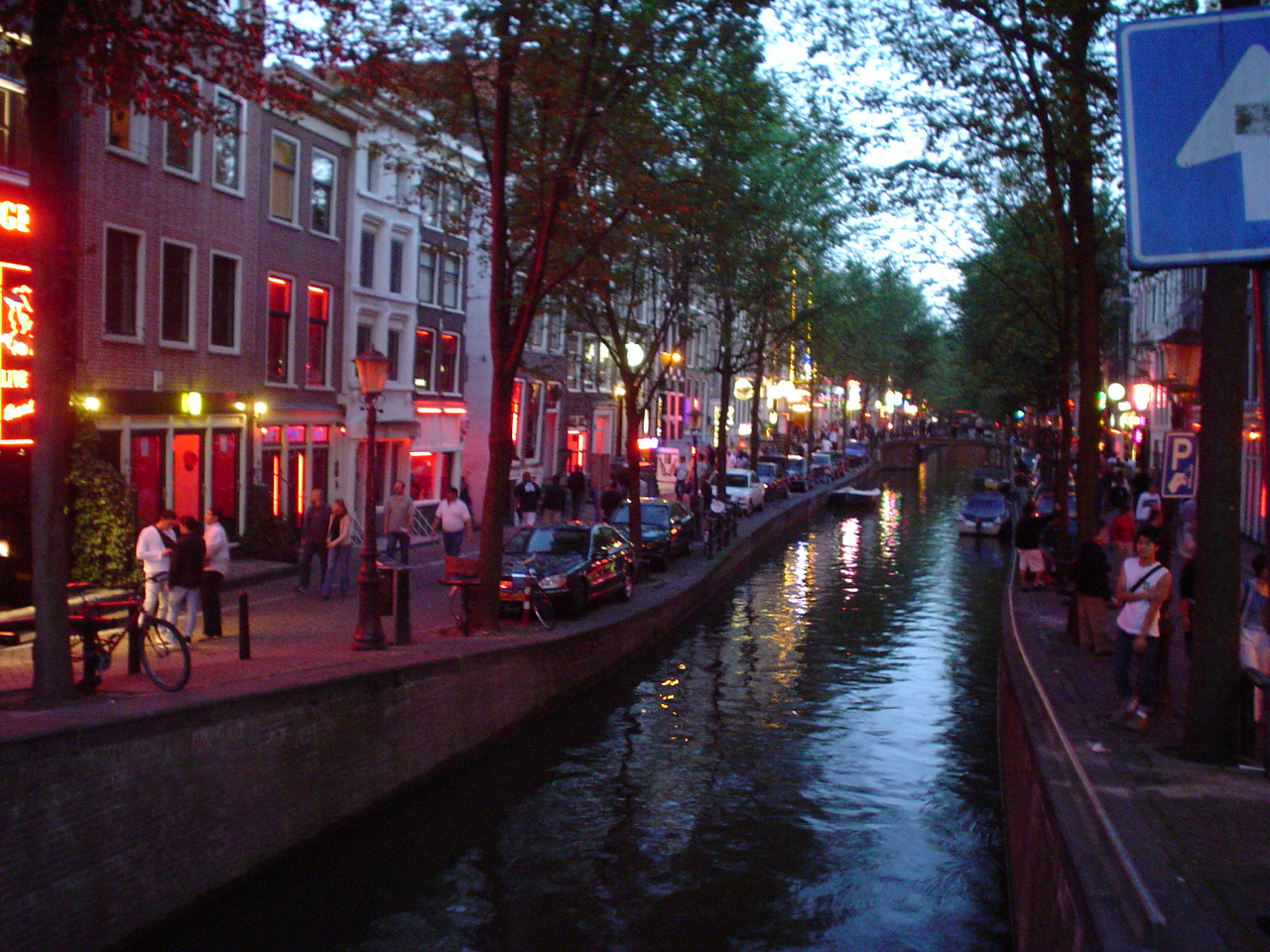 |
| Amsterdam's Red Light District. [NB: This photo is not mine!] |
Oh, yes, the next few weeks will be very exciting!


