Showing posts with label Margaret Thatcher. Show all posts

Tuesday, May 8, 2012

Windsor Castle (Part IV): The State Apartments


Let’s finish with my trip to Windsor Castle, shall we? (Especially since I plan on having many more photos to discuss over the coming weeks!) After visiting St George’s Chapel and Queen Mary’s Dolls’ House, I made my way—alongside EN and AT—into the main part of the castle.


The top of the Grande Staircase
We climbed the Grand Staircase—which is filled with glistening arms and armor, and dominated by a statue of Queen Victoria (that I was sadly not able to photograph due to palace officials)—and moved toward…

THE STATE APARTMENTS

Suffice to say, these Apartments are a bit grander and more formal than mine and Nic’s tiny studio apartment. In fact, you could probably fit our entire building in some of these rooms. But, such size is necessary given the functions they hold (e.g., a cozy dinner for 162 of The Queen’s closest dignitary friends). And as far as beauty goes, the Apartments house works of art by the likes of da Vinci and Rembrandt, and armor once worn by the likes of King Henry VIII.

Visitors to Windsor are allowed to visit the following State Apartments (whose names are somewhat deceptive at times):

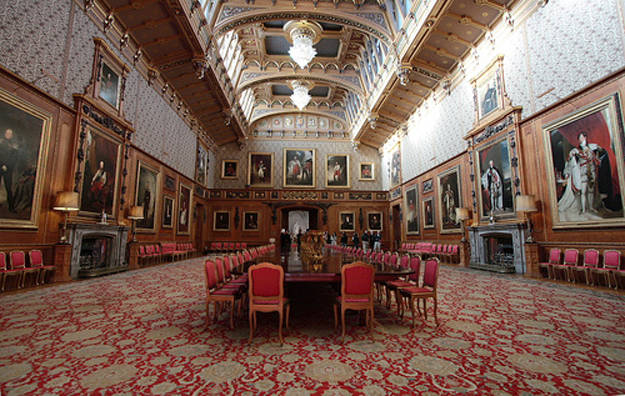
The Waterloo Chamber: Built to honor the defeat of Napoleon, this chamber was once an open courtyard. Today it holds many famous paintings, the largest known seamless rug in existence, and is used to stage concerts and other private performances.


[NB: This image is not mine!]

 The King’s Drawing Room: This room features many works of art, and a clock from 1730 that still plays music!


[NB: This image is not mine!]

 The King’s Bedchamber: Though there is a bed, the Sovereign does not actually sleep here. Rather, it is used for formal ceremonies (i.e., telling the King goodnight—formally—before he goes to bed elsewhere).


[NB: This photo is not mine!]

 The King’s Dressing Room: This room has served as both the Sovereign’s private bedroom and, later, as a dressing room. Now it holds a collection of Italian Renaissance paintings.


[NB: This image is not mine!]

 The Queen’s Drawing Room: Like the King’s Drawing Room, this chamber features many impressive works of art, including royal portraits of various Tudors and Stuarts. Also in this room is the famous Portrait of Charles I in three positions by Van Dyke. 


[NB: This image is not mine!]

 The King’s Dining Room: Located between the Queen’s and the King’s Apartments, the room served as the dining room for King Charles II.

[NB: This image is not mine!]

 The Queen’s Ballroom: As its name suggests, this long room was used for dancing (though I have a hard time imagining so many large gowns in such a narrow room!).


[NB: This image is not mine!]

 The Queen’s Presence Chamber and Audience Chamber:  The former is essentially an anteroom used by visitors before they are brought before Her Majesty in the Audience Chamber. (NB: Given that they are open to visitors, I doubt the current Queen actually uses these rooms for this purpose—though I could certainly be wrong!)
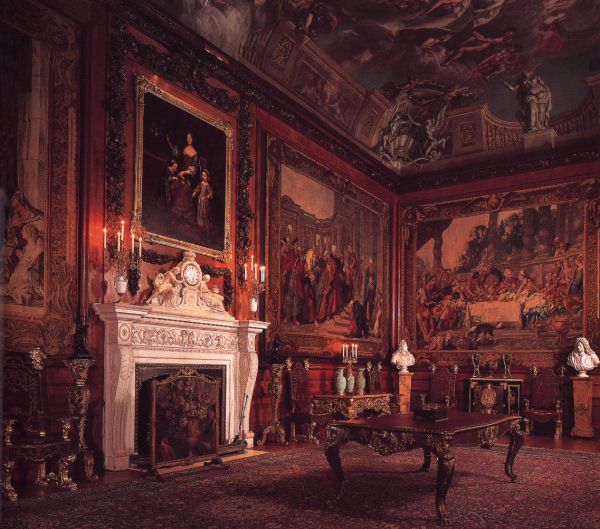

[NB: This image is not mine!]

 The Lantern Lobby: This room marks the spot where a private chapel once stood. It is also the spot where the 1992 fire broke out, which is commemorated with a large plaque.


[NB: This image is not mine!]

 St George’s Hall: This room is ginormous! At 30’ x 185’, this room is used for State banquets—a 175’ long dining room table is brought in which can seat up to 162 guests. There are also panels on the ceiling and elsewhere that are inscribed with the names of various knights. According to one source, the plain white shields mark Garter Knights were have been disgraced by crime or treason.


[NB: This image is not mine!]

 Also on display in St George's Hall is the black armor used by the King's / Queen's Champion from the time of King James I through George IV. It is this figure's role to act as the champion of the new Sovereign at their coronation, in the (unlikely) event of a challenge to the throne being issued. It was required of the Champion that (s)he ride, in full armor, into Westminster Hall during the coronation banquet and await any challengers. (NB: The Sovereign—by virtue of rank—could not face his or her challengers in single combat.) 

A purely ceremonial position today, Queen Elizabeth II's current Champion is Lieutenant-Colonel John Lindley Marmion Dymoke, Lord of the Manor of Scrivelsbry and the Manor of Telford—he acted as Standard-Bearer of the Union Jack at Her Majesty's coronation ceremony in 1953.


Moving on... since The Queen wasn’t in residence, we were also allowed to visit some of the...

SEMI-STATE APARTMENTS

These Apartments were created for King George IV in the 19th Century. Today, Queen Elizabeth II uses them for entertaining. These rooms are made up of the Green and Crimson Drawing Rooms, the State Dining Room, the Octagon Dining Room, the China Corridor, the Grand Reception Room, and the Garter Throne Room.

This last one is the one I’m most interested in. Before being converted, the Garter Throne Room was actually two separate rooms, the King’s Presence and Audience Chambers. Today, it is where The Queen conducts investiture ceremonies for new Knights and Ladies of the Garter prior to their installation in St George’s Chapel on Garter Day.


The Queen's throne is the white chair in the distance.
[NB: This image is not mine!]

Now, you may be asking yourself, ‘What is Garter Day, and who are these Knights and Ladies?’

Well, this is the highest order of chivalry that one can be invested with in England, and its doling out is entirely at the discretion of the Sovereign. Membership is limited to the Sovereign, the Prince of Wales, and no more than 24 others at any one time (meaning that new members have to wait an existing knight or lady vacates their position). The emblem is a blue garter with the motto ‘Honi soit qui mal y pense’ (‘Shame upon him who thinks evil upon it’) embossed in gold. The Order was founded in 1344 by King Edward III.

In addition to Queen Elizabeth II and Prince Charles, other current members include: Prince William; the Princess Royal; the Dukes of Kent, Gloucester, York, and Wessex; the Kings of Spain, Sweden, and Norway; the Queens of Denmark and the Netherlands; the Emperor of Japan; former Prime Ministers Margaret Thatcher and John Major; and Baroness Soames (the only surviving daughter of Winston Churchill).


[NB: This image is not mine!]
[NB: This image is not mine!]

 Well, that’s all that I have to say about the interior—especially since we (obviously) couldn’t visit the section cordoned off for the Royal Family’s private Apartments. 

(However, you can see them from the outside in the photos below of the Upper Yard. The wall farthest away is where the private Apartments are located, and the wall running along the right-hand side is for official guests of Her Majesty. The entrance seen in the middle is the exterior entrance to that section.)


I hope you’ve enjoyed this little play-by-play of my trip to Windsor, and that you haven’t minded too much my geeking out!

Until next time…

Wednesday, February 15, 2012

8 Mile (Part III): The Evening

Dusk was drawing close, and with it the end of our day. EN and I did, however, make a few more brief stops:

The first was St James’s Palace, site of the official Royal Court, and the official palace until the reign of Queen Victoria

Do you think that's the Royal Winnebago?

 Other than the historical aspect of it all (it is one of the oldest palace), and the fact that it’s the official residence of the Princess Royal (Queen Elizabeth’sdaughter) there really wasn’t much to see. However, one of my all-time-favorite memorials is on the palace grounds, hence the visit:


This piece is dedicated to the memory of Queen Alexandra, the daughter-in-law of Queen Victoria, and great-grandmother of Queen Elizabeth II.

I can’t say too much about the piece, beyond the fact that I just think it’s striking, and so different compared to many other memorials I’ve encountered here. Also, as someone who is fascinated by the queens of England, I find Queen Alexandra—especially her relationships with Queens Victoria and (later) Mary—a very interesting figure.

After saying hello to Her Majesty’s memorial, EN and I took a quick stroll down Constitution Hill, alongside Buckingham Palace, and briefly set-foot in Hyde Park. By that point, it was simply too dark and cold, however (as evidenced by the poor photo below), and so we set-off for the tube…


But not before swinging by Eaton Square to look for former Prime Minister Margaret Thatcher’s residence. Nic wanted me to tell her how much we enjoyed her in ‘Death Becomes Her’ and ‘The Hours (but, so help me, notMamma Mia!’), but no such luck. 


Ah well, perhaps next time…

FIN!

PS: In case you were wondering, we walked about 8 miles total.


Tuesday, February 7, 2012

The Iron (Yet Oddly Infirm) Lady...


So, I just finished watching Meryl Streep in “The Iron Lady.” 


As always, I cannot say enough good about the divine Meryl Streep—I have loved her performances in practically everything she’s done, and this is no exception. Indeed, her physicality in “The Iron Lady” made me honestly forget from time-to-time that she was not an 86 year old woman.

Yet, regarding the movie itself, I cannot help but cry out: “You’re a walking lie; and I can see right THROUGH you!


Please note that I’m about to start discussing spoilers from the film, so, if you haven’t seen it yet, you might want to avoid the rest of this post…


“[Margaret Thatcher] made popular a host of right-wing prejudices and homilies such as comparing government expenditure to household spending, and denying the logic of Keynesian economics, stating that governments could not spend their way out of recession...Across the Atlantic, Ronald Reagan used a similar, simple language to mark a new era of government. Each sought to reconfigure the state, getting out of welfare and macroeconomic management while pouring public resources into defence, security and foreign affairs.”  ~ Gerry Hassan and Anthony Barnett, Breaking out of Britain’s Neo-Liberal State (2009)

There are two different stories being told in “The Iron Lady:” 

The first story—and the one I feel the creators want us to pay closest attention to—is that of an older woman. In the here-and-now (2011), she is seen as merely a shadow of her former self, plagued by dementia and grief-stricken over the loss of her husband (Denis) some eight years prior. This woman’s worried daughter (Carol), personal assistant(?), and absentee son (Mark) all conspire to keep her—once Britain’s first female Prime Minister—out of the public eye, while the ‘ghost’ of her dead husband follows her around and reminds her of bygone moments in her life.


The story of an older woman...


The second story—the ‘B-story,’ if you will—is more-or-less that of Margaret Thatcher’s political career. It follows her inculcation in conservative politics through her father (a lapsed liberal, more or less), touches upon her time at Oxford (where she met Denis), and glosses almost entirely over her time as a lawyer, an MP, Education Secretary, and Leader of the Opposition—i.e., approximately 26 years of her life. 

What we instead receive is a rose-colored—no, I won’t go that far—salmon-colored version of Thatcher’s time as Prime Minister. Audiences receive glimpses of the troubling Brixton Riots (1981), the divisive and socially-explosive miners’ strike (1984-85), and even a somewhat longer look at the militarized re-occupation of the Falklands (1982). But, by the end, these issues are set aside and audiences are nonetheless still left with hints at economic prosperity as a result of Thatcher’s “hard medicine,” neoliberal policies.


Thatcher (Streep) approaches No. 10 as Prime Minister

“…the core twin principles of Thatcher’s regime: the intensification of centralised executive authority and the cultivation of an elite order at ease with a politics focused on winners, wealth and corporate logic—a neo-liberal regime.” ~ Gerry Hassan and Anthony Barnett, Breaking out of Britain’s Neo-Liberal State (2009)

Okay, so just like there are two stories going on in “The Iron Lady,” I have two reactions:

My first reaction: If I allow myself to parse-out the narrative about the older woman coping with loss and our cultural treatment of the longer-lived* (thereby eliminating the problems of Thatcherism all together), then I have to say ‘kudos’ to the creators for a decent effort. 

The opening scene in the convenience store represents our collective intolerance, and the invisibility of the aged (especially women). Likewise, the scenes with the older woman’s children and assistant demonstrate the way we infantilize those of an advanced age because we assume they are mentally deficient and incapable of taking care of themselves—’cause, God knows, we can’t be bothered to actually talk to them, and find out what they’re thinking and feeling! 


He cuts her off without even seeing her...

In essence, “The Iron Lady’s” primary narrative showcases our cultural view of the elderly as a problem that we don’t quite no how to deal with (and so we don’t). Nonetheless, in the end, the film’s creators problematize that cultural assumption by having the older woman take a dose of her own “hard medicine” and send her husband’s ghost packing—literally!—thereby challenging the audience’s assumptions about her ineptitude and feebleness. 


Denis is sent off...

My second reaction: By juxtaposing Thatcher’s pernicious premiership against the dominant cultural assumptions UK/US cultures makes about longer-lived women, the film’s creators have attempted to make Thatcher’s actions (and, by extension, her neoliberal policies) seem relatively non-threatening in the grand-scheme of things. 

Similarly, by playing to ideologically-rooted—and emotionally-ladden—myths of (grand-)motherness, as well as our collective sympathies (to the extent that they exist) for the mentally infirm, audiences are left actually rooting for and excusing the actions of a woman whose tenure in office was marked by greater attention to corporate interests than the proverbial ‘little guy.’


(This is not to say that I was so distracted by such coded messages that I fell fully into the creators’ trap; but, I confess, there were times where I found myself thinking “Aww, she wasn’t so bad, really”—at which point I would promptly slap myself in the face and come back to my senses!)

So, yeah: all-in-all, there were definitely some problems with “The Iron Lady.” 

Was it worth watching? Sure. I’m a huge Meryl Streep fan, and I cannot deny that she does a remarkable job assuming the role of former PM Margaret Thatcher. Also, the makeup was superb, and what I have referred to throughout as the ‘A-story’ is very (bitter-)sweet. 


Thatcher at the Doctor's
 
I would simply caution viewers to be careful that they don’t get so swept-up in our society’s culturally-rooted ideas about age, gender, and disease, that they forget the social- and economic-reality of Thatcher’s problematic premiership.

* I think I’m reasonably safe in assuming that today’s British culture treats longer-lived persons in roughly the same way as modern US American culture.